
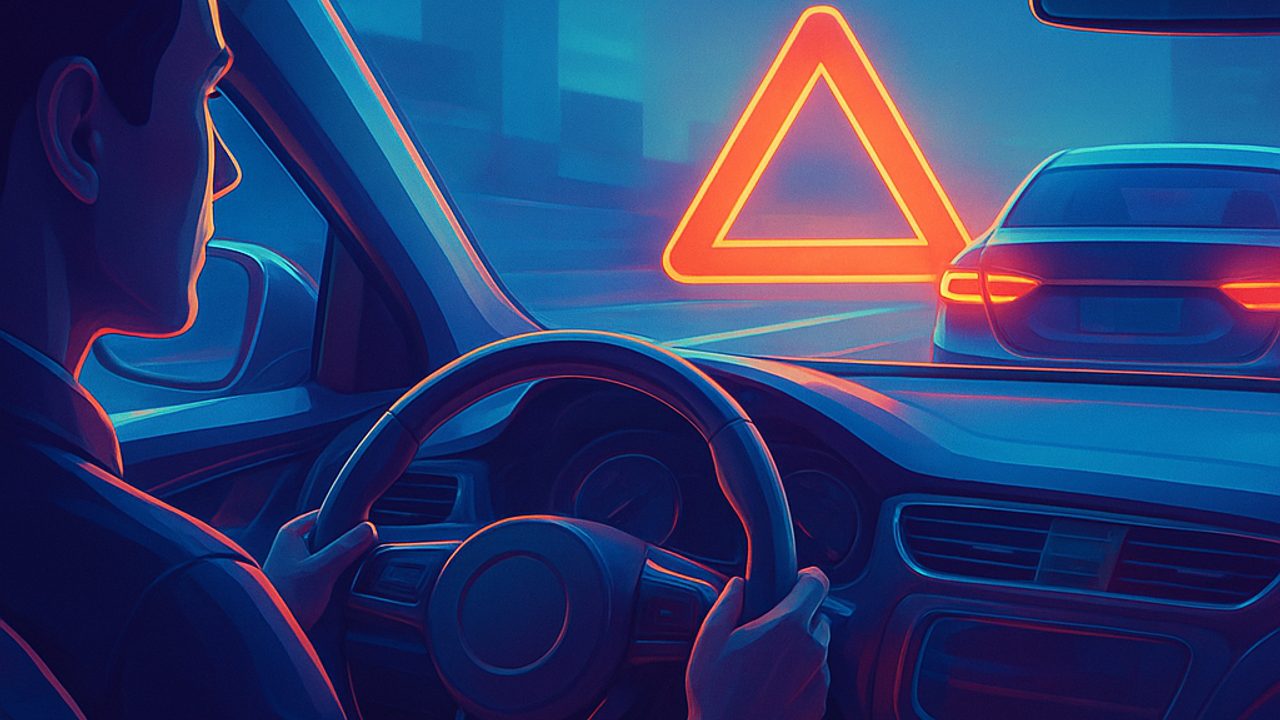
Most rear-end collisions don’t happen because of excessive speed, but because of lack of space. Just a few fewer seconds are enough for a normal brake to turn into an impact.
In everyday driving, following distance often decreases without the driver noticing. Heavy traffic, haste, and distractions push the car too close to the vehicle ahead.
What following distance means in practice
Following distance is the space between your vehicle and the one in front that allows you to react safely to an unexpected brake. It’s not a fixed number in meters, but in time.
The most commonly used rule in daily driving is simple: choose a fixed point on the road (a pole, sign, or shadow). When the vehicle ahead passes that point, count how many seconds it takes you to pass the same spot.
- Dry urban traffic: at least 2 seconds - Highway or higher speed: 3 seconds or more - Rain, fog, or slippery pavement: add 1 or 2 more seconds
Sign 1: you brake at the same time as the car ahead
If every brake by the vehicle ahead requires an immediate reaction from you, the distance is already too short. There’s no time to assess, only to react.
This increases the risk of chain collisions, especially in stop-and-go congestion.
What to do day to day
- Ease off the accelerator earlier - Let the car “roll” before braking - Recreate the space by counting the seconds again
Sign 2: you can’t see the tires of the car ahead when stopped
At traffic lights or in queues, a good indicator is being able to see the rear tires of the vehicle ahead touching the pavement. If they disappear from your field of vision, you’re too close.
This proximity makes evasive maneuvers harder and increases the risk of impact from small distractions.
What to do day to day
- Stop a little earlier behind the car ahead - Use visual references on the hood or dashboard - Avoid inching forward with every small movement of the line
Sign 3: other vehicles easily merge between you and the car ahead
If cars and motorcycles constantly move into the space in front of you, it doesn’t mean the gap is “too big.” Most of the time, it’s simply appropriate.
Reducing that space out of irritation is a common and dangerous mistake.
What to do day to day
- Maintain the distance even after someone merges - Recount the seconds calmly - Remember that the space is your safety margin, not an invitation
Why following distance prevents accidents
With enough space, you:
- Brake progressively, without panic - Avoid rear-end collisions in sudden braking - Gain time to steer around obstacles - Reduce stress while driving
Simple adjustments that make a difference every day
- Anticipate traffic by looking beyond the car ahead - Double the distance in rain, at night, or with a load - Avoid tailgating to “pressure” other drivers
Following distance doesn’t delay your trip. On the contrary: it brings flow, predictability, and greatly reduces the chances of an accident that could be avoided with just a few extra seconds.
Comments
Comments are public and the sole responsibility of the author. Don’t share personal data. We may store technical signals (e.g. IP hash) to reduce spam and remove abusive, illegal, or off-topic content.