
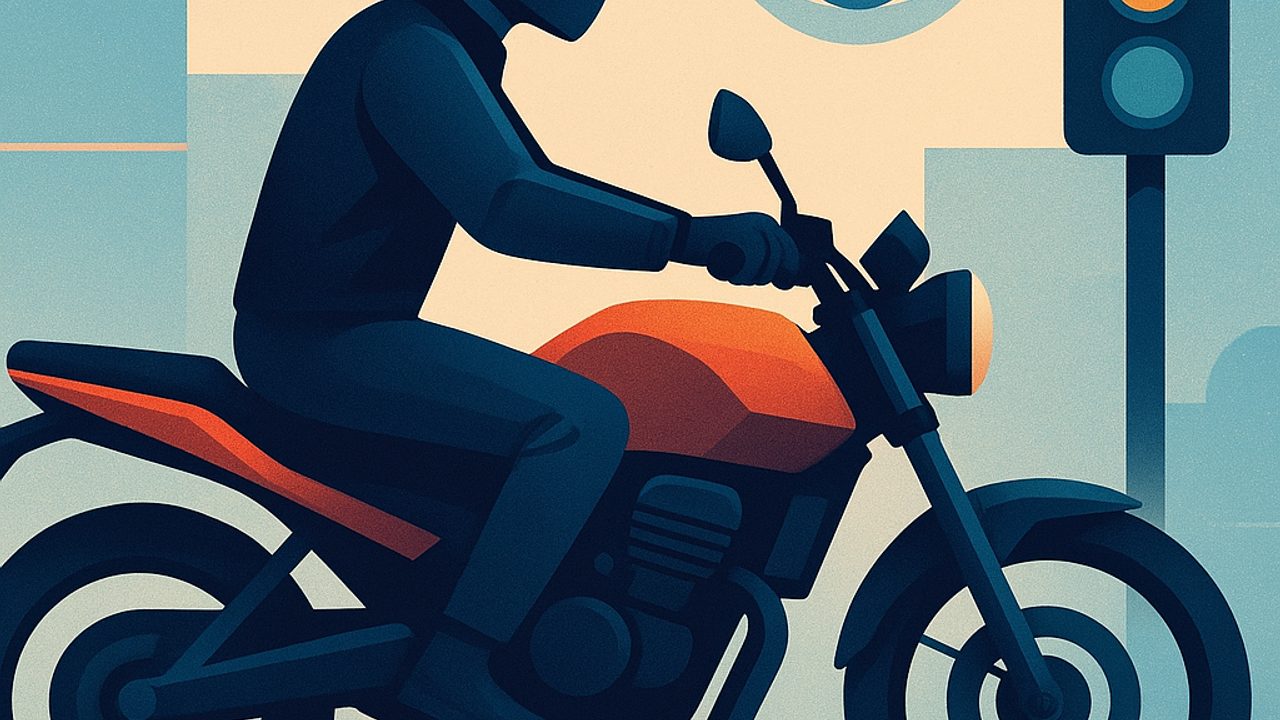
Motorcycles accelerate quickly, change lanes easily, and often stay outside the beginner driver’s field of vision. Most conflicts arise from details: where the motorcycle is on the road, whether it was seen in time, and how the car brakes in front of it.
Below are three essential items for everyday driving. They are simple habits focused on accident prevention, especially in urban traffic.
1) Motorcycle position on the road: where to expect it
Motorcycles are not fixed to the center of the lane. They travel along the sides, take advantage of gaps, and can appear from places a beginner does not expect.
- On urban roads, assume the motorcycle may be **to the left or to the right of your car**, even within the same lane. - In lane-splitting, it appears **between stopped or slow lanes**. Before changing lanes, think: “does a motorcycle fit here?”. - At intersections, many motorcycles move up to the stop line. When pulling away, check mirrors and blind spots.
Treating the motorcycle as a “potentially invisible vehicle” helps maintain a safety margin.
Common mistake
Looking only at the center of the lane when changing direction. The motorcycle is usually laterally offset.
2) Visibility: seeing and being seen at the right time
The biggest risk is not the motorcycle being close; it is **not noticing it in time**. Visibility depends on routine, not luck.
- Use mirrors methodically: rearview mirror, side mirror, turn signal, and a quick recheck. - Pay extra attention when pulling out of parking spaces, entering fast roads, and making left turns. - At night or in the rain, remember that a motorcycle’s headlight may seem farther away than it really is.
If there is doubt, wait. An extra half second prevents hasty decisions.
3) Braking: space and predictability save lives
Motorcycles can brake faster than cars in some situations. In others, they need more space because of balance.
- Keep **greater distance** when following a motorcycle, especially on uneven pavement. - Avoid hard braking behind it. Anticipate deceleration by easing off the accelerator first. - On descents, in rain, or on cobblestones, expect less predictable reactions.
Braking smoothly gives the motorcycle time to react and keeps control of your own vehicle.
Typical risky situation
The traffic light turns green, the motorcycle accelerates quickly and then slows down shortly ahead. Those who accelerate too much and brake abruptly create the conflict.
Intersections and turns: the critical point
A large share of accidents happens at intersections. The motorcycle comes through “clean,” without obstacles, and disappears behind the car’s pillar.
- Come to a complete stop before crossing priority roads. - Move your head to widen your field of view. - Be wary of small gaps in traffic flow: a motorcycle may be coming.
Quick checklist to remember day to day
- ✅ Look for motorcycles at the sides of the lane, not just ahead - ✅ Check mirrors and blind spots before any maneuver - ✅ Increase following distance and brake progressively
These three precautions — road position, visibility, and braking — form a simple and effective tripod. For those just starting to drive, incorporating them into the routine reduces scares, conflicts, and accidents, making traffic more predictable for everyone.
Comments
Comments are public and the sole responsibility of the author. Don’t share personal data. We may store technical signals (e.g. IP hash) to reduce spam and remove abusive, illegal, or off-topic content.