
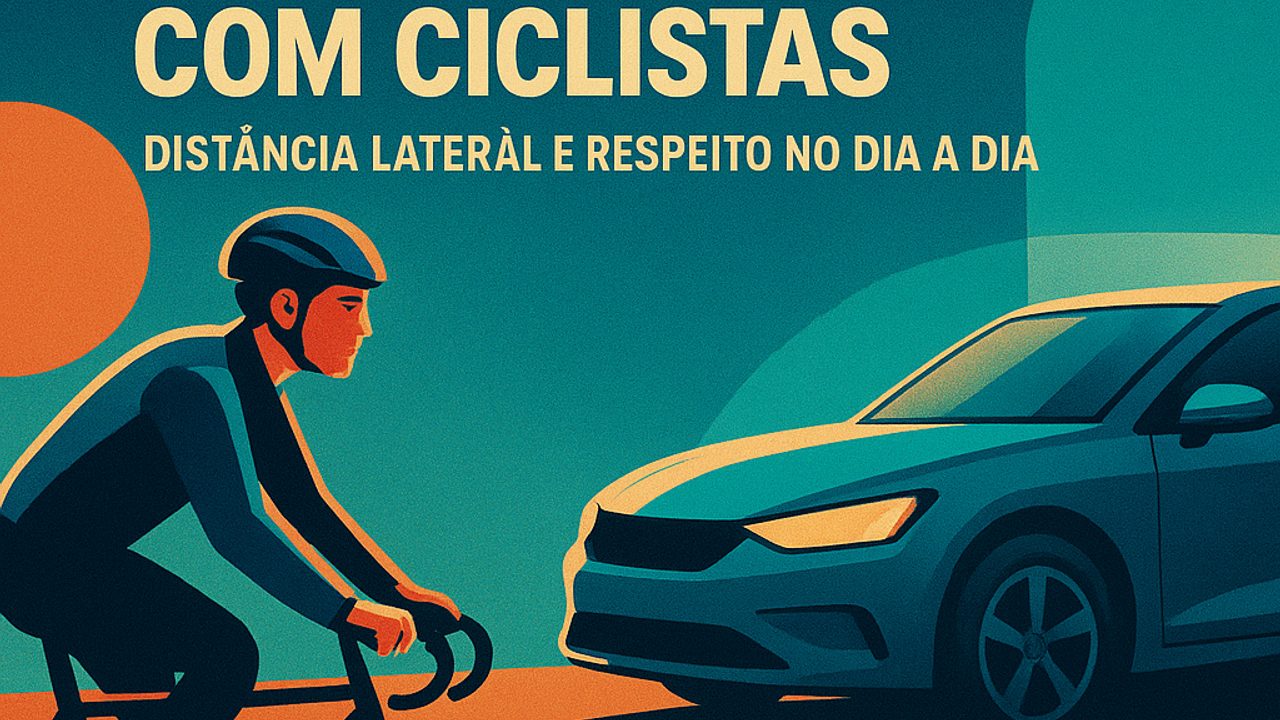
Bicycles are part of traffic, whether on a busy avenue or a neighborhood street. Most conflicts arise from wrong expectations: those who think “nothing will happen” or that “the other should get out of the way.”
In daily life, preventing accidents with cyclists has less to do with heroics and more to do with simple habits, repeated consistently. Understanding what is myth and what is truth helps adjust driving before a situation becomes critical.
Myth: passing quickly reduces risk
The idea that “the less time next to the cyclist, the better” is common — and dangerous. Rushing usually reduces lateral distance and increases the scare factor.
**Truth:** passing calmly and with space is safer. Cyclists may swerve to avoid potholes, grates, or slightly adjust their line to maintain balance. A car that passes too close leaves no room to react.
In practice: - Slightly reduce speed before overtaking. - Wait a few seconds if there is not enough space. - Complete the maneuver only when you can maintain a comfortable distance along the entire stretch.
Truth: lateral distance saves time — and prevents falls
Maintaining good lateral distance is not a courtesy; it is prevention. It compensates for small human errors and road irregularities.
Even at low speed, the air displacement from a car can destabilize a bicycle. On narrow streets, lateral distance acts as a “cushion” for the unexpected.
Warning sign: if you feel like you have to “hold your breath” to pass, there is not enough space.
Myth: cyclists should always stay tight to the right
Many drivers are surprised when a cyclist occupies more of the lane. It may seem provocative, but it is usually self-protection.
**Truth:** cyclists may position themselves closer to the center to avoid opening car doors, drains, debris, or to be more visible. Being squeezed to the right increases the risk of a fall.
As a driver, it is worth observing the context: - Are there parked cars with doors opening? - Is the pavement uneven? - Is there an intersection nearby?
These factors explain the cyclist’s position and call for more patience.
Myth: honking helps warn
The horn is usually interpreted as a threat, not a warning. The startle can lead to an abrupt handlebar movement.
**Truth:** the best communication is predictable and silent. Steady speed, signaling in advance, and space speak louder than any sound.
Use the horn only in immediate danger, when there is no other way to avoid a collision.
Lateral distance in everyday life: where it matters most
There are situations where lateral distance becomes an absolute priority:
- **Narrow neighborhood streets:** children, animals, and obstacles appear out of nowhere. - **Uphills:** the cyclist may sway the bike more due to effort. - **Downhills:** speed increases, and any contact can become a serious fall. - **Rain or wind:** bicycle control becomes more unstable.
In these scenarios, holding off on overtaking for a few seconds is usually the safest decision.
Myth: cyclists “don’t follow rules,” so the care is their responsibility
Generalizations hinder reading traffic conditions. There are reckless cyclists, just as there are reckless drivers.
**Truth:** safety works best when everyone assumes their share. The larger, heavier vehicle has greater potential to cause harm — and also more resources to avoid a collision.
Thinking in terms of shared responsibility reduces tension and improves decisions behind the wheel.
Small habits that prevent conflicts
Some simple attitudes reduce almost all friction with cyclists:
- Look twice before opening a car door. - Check the mirror when changing lanes, even on calm roads. - Pay extra attention at intersections, where bicycles appear quickly. - Avoid overtaking and immediately turning, “cutting off” the cyclist.
These gestures take seconds and prevent serious situations.
Respect is not a favor, it is a safety strategy
Coexisting with cyclists does not require advanced technical knowledge. It requires reading the environment, maintaining a safety margin, and making less impulsive decisions.
When drivers understand that lateral distance and respect protect everyone — including those behind the wheel — traffic flows better. Not because of rules, but because of common sense applied to everyday life.
Comments
Comments are public and the sole responsibility of the author. Don’t share personal data. We may store technical signals (e.g. IP hash) to reduce spam and remove abusive, illegal, or off-topic content.