
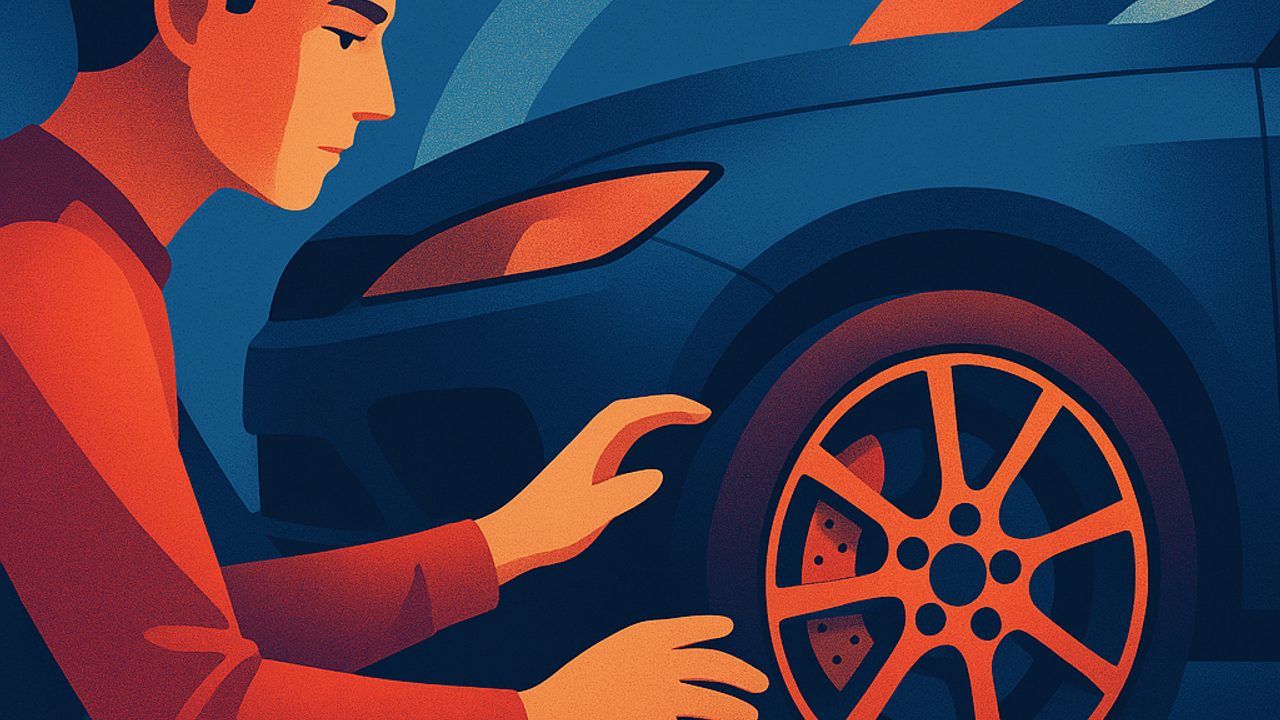
For those who are just starting to drive, many things compete for attention: rules, traffic flow, mirrors, pedestrians. In this scenario, two items work quietly to prevent accidents: tires and brakes.
They don’t draw attention until they fail. In everyday driving, taking care of these systems is a simple way to gain a safety margin — especially during emergency braking, curves, and on wet roads.
Tires: the car’s only contact with the ground
Tires are responsible for accelerating, braking, and keeping the car on its path. Any neglect here affects everything else.
Proper tire pressure changes the car’s behavior
Driving with underinflated or overinflated tires alters stability and stopping distance.
- Underinflated tires increase fuel consumption, heat up more, and respond more slowly to steering. - Overinflated tires reduce the contact area and worsen grip.
Get into the habit of checking tire pressure when the tires are cold and following the pressure indicated by the vehicle manufacturer — not the one written on the tire sidewall.
Wear and the safety limit
Every tire has wear indicators (TWI). When the rubber reaches this level, the ability to channel water drops significantly.
In daily use, this means:
- Greater risk of aquaplaning in light rain. - Less grip during hard braking. - Loss of control in simple curves.
Checking the tread once a week already helps avoid surprises.
Brakes: reaction time doesn’t make up for mechanical failure
Even with full attention, the brakes need to respond at the right moment. For beginners, understanding the system’s warning signs is essential.
Warning signs that should not be ignored
Some indications appear before a serious problem:
- Very low or very hard brake pedal. - Metallic noises when braking. - Steering wheel vibration during braking.
These signs affect stopping distance and the car’s predictability, two critical factors in preventing collisions.
Safe following distance depends on well-maintained brakes
Keeping distance from the vehicle ahead is a basic rule, but it only works if the brakes are efficient.
In urban traffic, worn brakes turn a common situation — someone braking ahead — into a real risk of a crash.
Tires and brakes work together — especially in the rain
On wet surfaces, grip is already reduced. Bald tires and tired brakes multiply the problem.
In everyday driving, this translates into:
- A car that “slides” even at low speed. - ABS activating more frequently. - A feeling of lack of control in roundabouts and gentle curves.
Taking care of both systems is a direct way to reduce stress when driving in the rain.
Simple habits that increase lifespan and safety
Some practices help tires and brakes work better:
- Avoid unnecessary hard acceleration and braking. - Reduce speed before speed bumps and potholes. - Do not rest your foot on the brake unnecessarily. - Respect the vehicle’s load limit.
These habits make the car easier to control and keep its response predictable.
Quick checklist for the beginner driver’s routine
Before a problem turns into a risk:
- Look at the tires when getting into the car. - Notice whether the brakes are responding as usual. - Pay attention to new noises or vibrations.
Tires and brakes do not require advanced technical knowledge, only constant attention. In real traffic, this attention is often the detail that prevents common everyday accidents.
Comments
Comments are public and the sole responsibility of the author. Don’t share personal data. We may store technical signals (e.g. IP hash) to reduce spam and remove abusive, illegal, or off-topic content.