
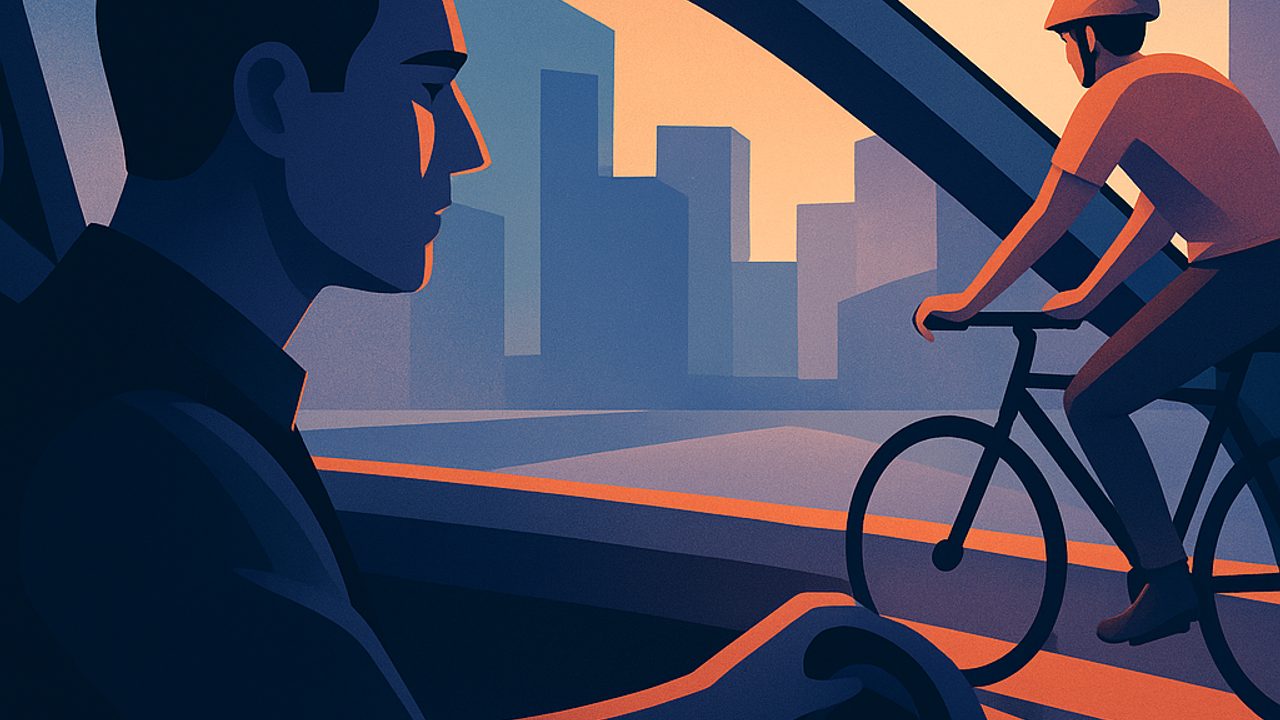
Sharing the road with cyclists is a reality on streets, avenues, and highways. For those just starting to drive, small behavior adjustments make a big difference in accident prevention.
Safe coexistence involves adequate lateral distance, reading the environment, and simple everyday choices that avoid scares, falls, and conflicts.
Why lateral distance matters so much
A bicycle is inherently unstable: potholes, wind, uneven surfaces, and obstacles force cyclists to make small deviations. When a car passes too close, any wobble becomes a risk.
Maintaining a comfortable lateral distance helps to:
- Avoid involuntary contact between mirror, handlebar, or body - Reduce the effect of the vehicle’s air displacement - Leave room for unexpected situations on the road
How much lateral distance to consider in practice
In everyday use, think of a margin that allows the cyclist to move safely without feeling “squeezed.” At higher speeds, this margin needs to increase.
Good practical references:
- On urban roads: enough space to open an imaginary door between car and bicycle - On highways or fast roads: even greater distance, with wide and calm overtaking
If there is no safe space to overtake, the most prudent choice is to slow down and wait.
Safe overtaking: timing and positioning
Overtaking a cyclist requires more planning than passing another car. Assess visibility, oncoming traffic, and road width.
Before overtaking:
- Reduce speed and maintain distance - Signal your intention in advance - Confirm there is space to return to the lane without cutting off the cyclist
During the maneuver, avoid sudden acceleration. Predictability is a key safety factor.
Extra attention at intersections and turns
A large portion of accidents happens at intersections, driveway entrances, and right turns.
Points of attention:
- Check mirrors and blind spots before turning - Remember that the cyclist may continue straight while you turn - Pay extra attention in shared lanes and near bike lanes
Open doors: a common and avoidable risk
When parking, the habit of opening the door without looking can cause serious falls. Before opening, check the mirror and look over your shoulder to identify approaching cyclists.
Coexistence in everyday situations
Some scenarios call for extra care:
- **Slow traffic:** avoid “squeezing” the cyclist between cars - **Rain and wind:** bicycle instability increases - **At night:** cyclists may be less visible; reduce speed
Patience and reading the context are just as important as technique.
Attitudes that build respect in traffic
Beyond technique, the driver’s attitude directly influences safety:
- Avoid honking to apply pressure - Do not compete for space - Recognize bicycles as part of traffic
Mutual respect and conservative decisions help turn ordinary trips into safer journeys for everyone.
Comments
Comments are public and the sole responsibility of the author. Don’t share personal data. We may store technical signals (e.g. IP hash) to reduce spam and remove abusive, illegal, or off-topic content.