
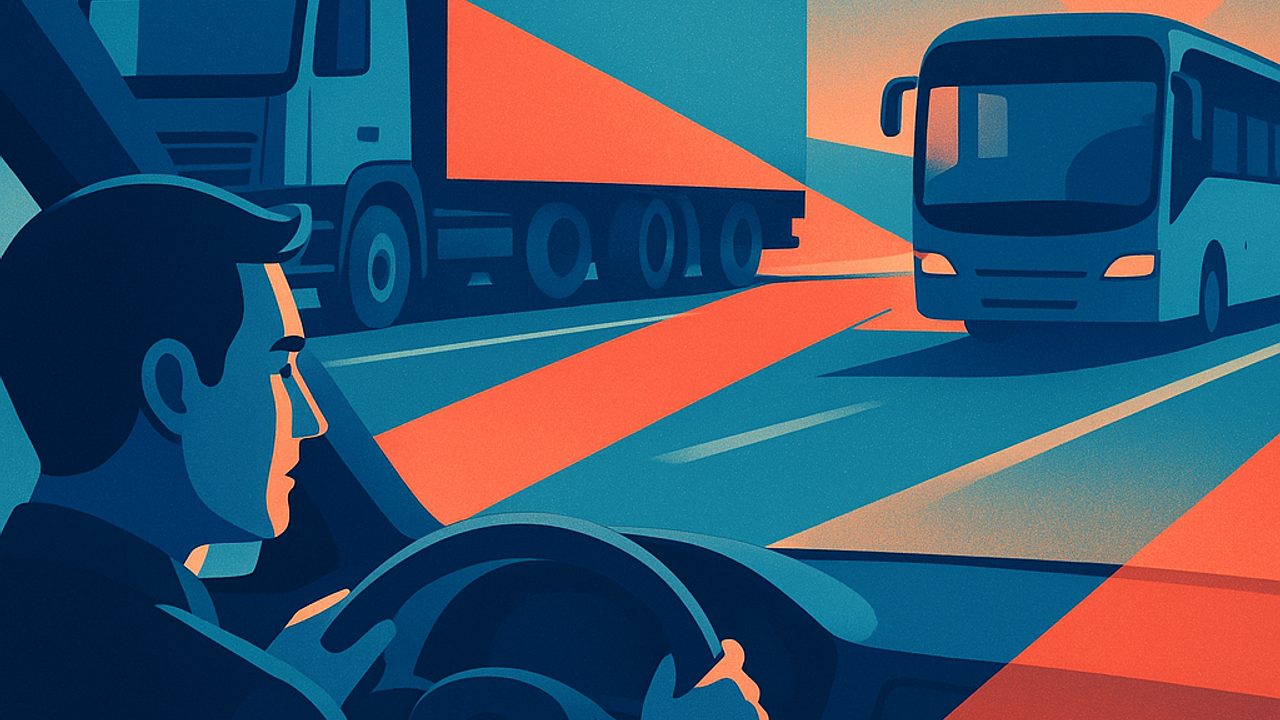
Blind spots are not a lapse in attention: they are physical limits of vision. They exist in cars, grow in trucks and buses, and become more treacherous in urban traffic, with motorcycles and bicycles appearing quickly.
The good news is that most collisions related to blind spots can be avoided with simple adjustments, active reading of the surroundings, and a clear sequence of actions before changing lanes or turning.
Understand where blind spots really are
Every vehicle has areas that escape the mirrors. In cars, they are usually to the side and slightly behind the rear doors. In trucks and buses, they include long sides, the area close to the front bumper, and a large area behind.
- **Cars**: rear sides and, in some models, the front pillar on curves. - **Trucks**: long sides, a low front (where a small car can disappear), and a wide rear. - **Buses**: sides and rear; doors and windows can mislead distance perception.
Recognizing these zones helps anticipate risks before any maneuver.
Mirror adjustment: the basics that make a difference
Poorly adjusted mirrors create unnecessary blind spots. Proper adjustment widens the field of view and reduces reliance on abrupt head movements.
- **Rearview mirror**: center the view of the rear, without tilting up or down. - **Side mirrors**: open them slightly more than usual, so that the side of your car barely appears. - **Quick check**: a vehicle leaving the rearview mirror should immediately appear in the side mirror.
Make this adjustment while parked and review it whenever someone else drives the car.
Safe sequence before changing lanes
Changing lanes is the classic moment for blind-spot collisions. A short sequence reduces the risk:
1. **Signal early** to indicate your intention. 2. **Check mirrors**, rearview and side. 3. **Quick glance over the shoulder** on the side of the maneuver. 4. **Change lanes smoothly**, without zigzagging.
This final quick glance is decisive, especially for motorcycles approaching at speed.
Sharing the road with motorcycles and bicycles: extra attention
Smaller vehicles stay hidden longer. In addition, they accelerate and brake differently.
- Wait an extra second after checking mirrors. - Avoid “cutting off” the path when turning right; bicycles may continue straight. - In traffic jams, watch for motorcycles between lanes: signal and confirm twice.
Larger size, greater risk: how to act near trucks and buses
Around large vehicles, assume that **you** are in their blind spot.
- Do not stay alongside for long; overtake decisively and with space. - Avoid stopping too close in front; the driver may not see your car when starting. - In curves and turns, keep distance: off-tracking is common.
At stops and traffic lights
Staying too close to the rear of buses and trucks limits your escape route. Extra space provides visibility and reaction time.
Advanced strategies for everyday urban driving
When traffic is dense, small choices help:
- **Plan your lane** in advance to avoid last-minute changes. - **Read behavior**: wheels turning, forgotten turn signals, slight vehicle drift. - **Use speed to your advantage**: adjust your pace to get out of others’ blind spots.
Rain, night, and curves: when the blind spot grows
Adverse conditions increase risks. At night, reflections and headlights deceive; in rain, spray hides motorcycles; on curves, car pillars block pedestrians.
- Reduce speed before the maneuver. - Increase lateral distance. - Reinforce the sequence: signal, mirrors, quick glance.
Blind spots do not disappear, but consistent habits turn a limitation into something predictable. In everyday driving, predictability is synonymous with safety.
Comments
Comments are public and the sole responsibility of the author. Don’t share personal data. We may store technical signals (e.g. IP hash) to reduce spam and remove abusive, illegal, or off-topic content.