
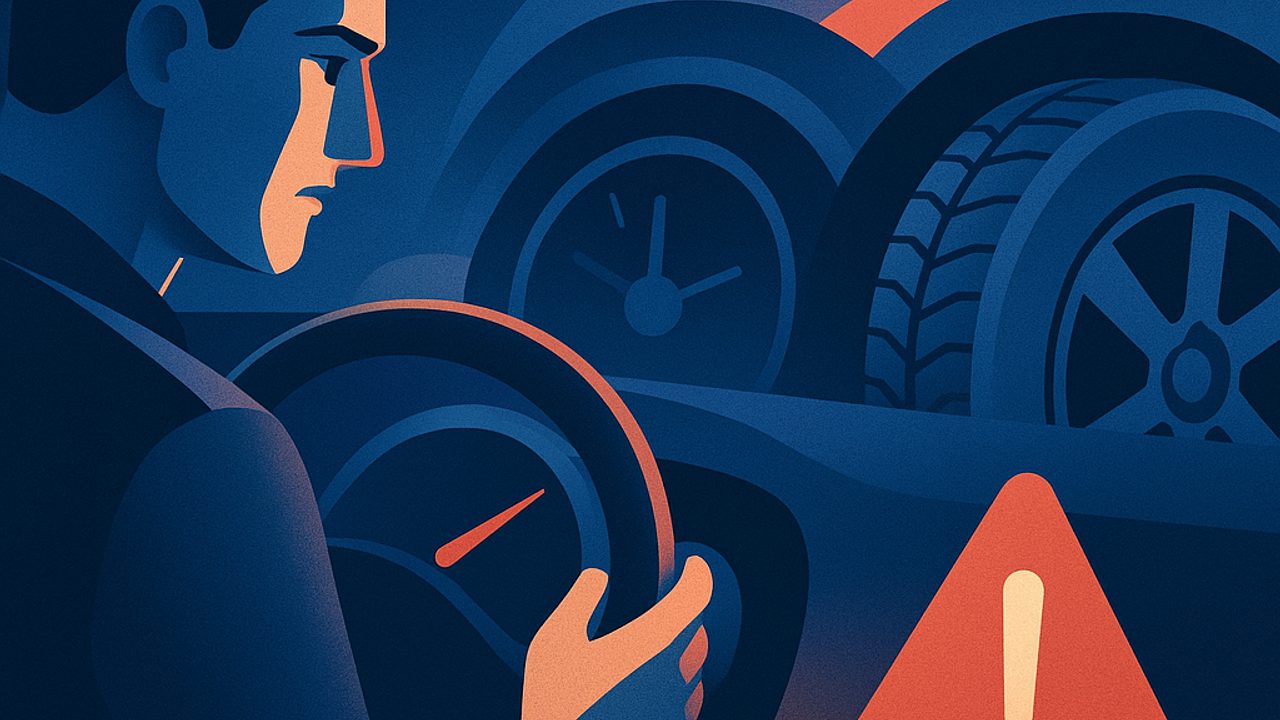
Alignment and balancing usually make the maintenance list only when something is already wrong. For those just starting out, this is common — and dangerous. These adjustments directly influence stability, braking, and vehicle control.
Ignoring the signs usually comes without prior warning. The car gradually gets the driver used to compensating for defects, until a risky situation appears. The good news: the warnings are easy to notice.
What alignment and balancing are (in a few words)
Alignment adjusts the wheel angles so they are parallel to each other and perpendicular to the ground. Balancing distributes the weight of the wheel/tire assembly so it rotates without vibrations.
When either one is out of spec, the car loses predictability. In simple maneuvers this is already uncomfortable; in an emergency braking situation, it makes a difference.
Sign 1: crooked steering wheel or car pulling to one side
On a flat road, lightly release the steering wheel for a second. If the car insists on going left or right, there is a high chance of misalignment.
Other common indications: - Steering wheel off-center even when driving straight - Constant need to correct the steering
What to do in this case
- Avoid “compensating” by driving with the steering wheel crooked - Schedule an alignment as soon as possible - Check whether there was a recent impact (pothole, curb, speed bump)
Driving like this tires the driver more and increases risk in curves and quick evasive maneuvers.
Sign 2: vibration in the steering wheel or floor
If the steering wheel shakes from a certain speed — usually between 60 and 90 km/h — the problem tends to be balancing. The vibration may also appear in the seat or floor.
This is not just discomfort. Vibration reduces tire grip on the road and impairs feedback about what the car is doing.
What to do in this case
- Look for wheel balancing - Ask to check for a deformed tire or bent wheel - Avoid long trips before the adjustment
The longer you drive like this, the greater the wear on suspension components and tires.
Sign 3: uneven tire wear
Look at the tread. If one side of the tire is worn smooth and the other still looks good, something is out of adjustment. This happens even in cars with low mileage.
Common patterns: - Wear only on the inner or outer edge - “Waves” or steps felt when running a hand over the tire
What to do in this case
- Perform alignment and balancing together - Assess whether the tire is still safe to use - Consider tire rotation after the adjustment, if recommended
A tire worn unevenly loses efficiency in the rain and increases braking distance.
When to do alignment and balancing, even without clear signs
Some situations call for preventive attention: - Tire replacement or repair - Strong impacts with potholes or curbs - Steering wheel removal or suspension work - At each periodic service, depending on usage
For those planning to sell the car, keeping these adjustments up to date improves driving feel during the test drive and avoids buyer concerns.
Safety comes before comfort
A straight steering wheel and a stable car are not luxuries. They are prerequisites for driving with a safety margin. For beginners, this helps build correct references for steering and vehicle response.
If something feels off while driving, trust the feeling. The car usually gives warnings — it’s up to the driver to listen.
Comments
Comments are public and the sole responsibility of the author. Don’t share personal data. We may store technical signals (e.g. IP hash) to reduce spam and remove abusive, illegal, or off-topic content.