
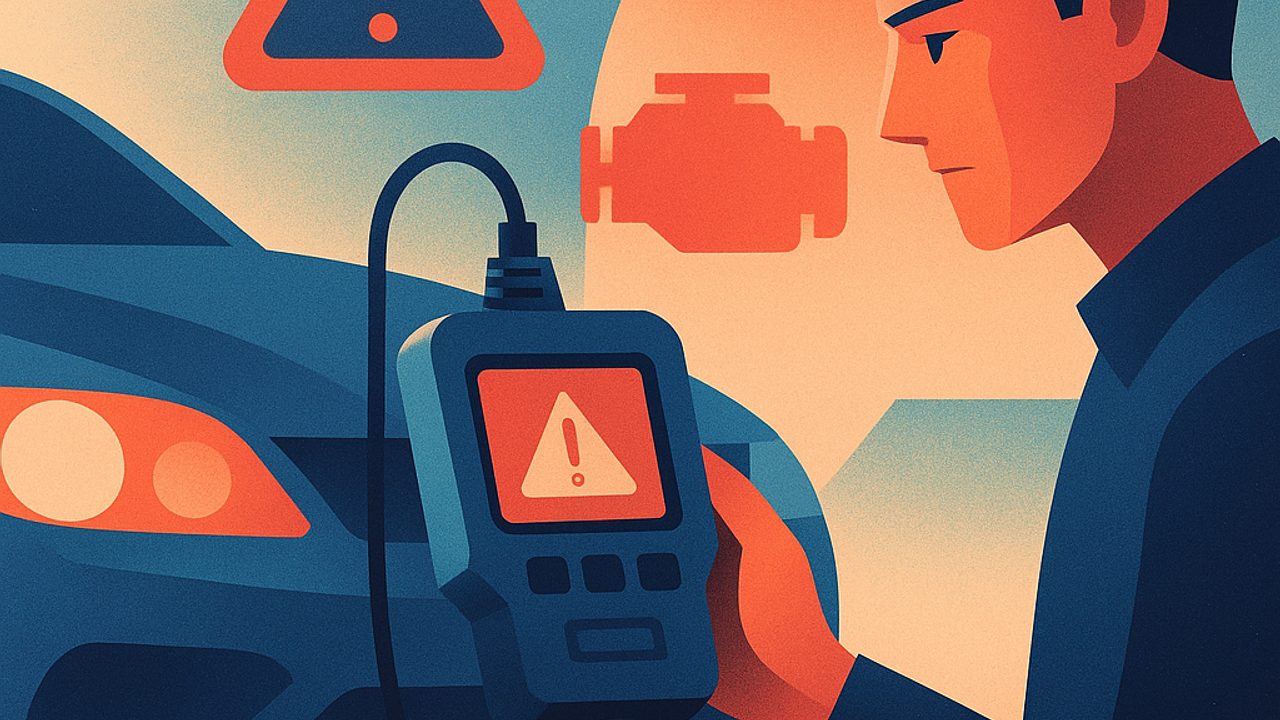
The OBD2 scanner has become a common item in the glove box. It reads codes, shows faults, and seems to give quick answers. The problem is treating a code as a definitive diagnosis.
Used calmly, OBD2 is a safety ally. Used without criteria, it can lead to wrong decisions. Below are three common warning signs for beginners — and what to do in each case.
First of all: a code is not a verdict
A code points to a **symptom**, not the exact cause. The same code can arise from a sensor, wiring, bad fuel, or a mechanical failure. Therefore, the reading should be the start of the investigation, not the end.
Keep this simple rule: **if there is immediate risk to drivability, stop driving**. If not, investigate methodically.
Sign 1: flashing check engine light or misfire code
When the check engine light flashes, the message is serious. It generally indicates an ignition failure (misfire), which can damage the catalytic converter and compromise safety.
What to do now
- Reduce speed and avoid hard acceleration. - If the car shakes, loses power, or makes irregular noise, pull over to a safe place. - Read the code, but **do not keep driving to “test” it**.
Ignoring this sign can increase the risk of a breakdown while moving and of fire in the exhaust.
Sign 2: codes related to engine temperature
Codes for the temperature sensor, thermostat, or cooling system deserve extra attention. Overheating affects brakes, steering, and can lead to a sudden stop.
What to do now
- Check the dashboard to see if the temperature is rising beyond normal. - Avoid heavy traffic and long uphill climbs. - If the temperature rises quickly, pull over and turn off the engine.
Driving “just a little longer” with a thermal warning is a common — and dangerous — mistake.
Sign 3: lean/rich mixture or emissions codes with loss of power
These codes don’t always seem urgent, but they can affect throttle response. During overtaking or at intersections, that becomes a risk.
What to do now
- Observe whether there is delay when accelerating or hesitation. - Avoid maneuvers that require immediate engine response. - Reread the code after a few kilometers to see if it returns.
If the car’s behavior has changed, treat it as a safety alert, not just a fuel economy issue.
Common mistakes when interpreting OBD2
- Replacing a part based only on the code. - Clearing the error without investigating the cause. - Ignoring the car’s behavior because “nothing serious showed up”.
The car speaks through codes **and** through driving sensations.
A simple and safe method for beginners
- Read the code and write it down. - Observe real symptoms: noises, smells, loss of power, dashboard lights. - Decide whether it is safe to keep driving or not. - If it persists, seek technical inspection with the information in hand.
OBD2 helps you ask better questions — and that already greatly increases everyday safety.
Comments
Comments are public and the sole responsibility of the author. Don’t share personal data. We may store technical signals (e.g. IP hash) to reduce spam and remove abusive, illegal, or off-topic content.