
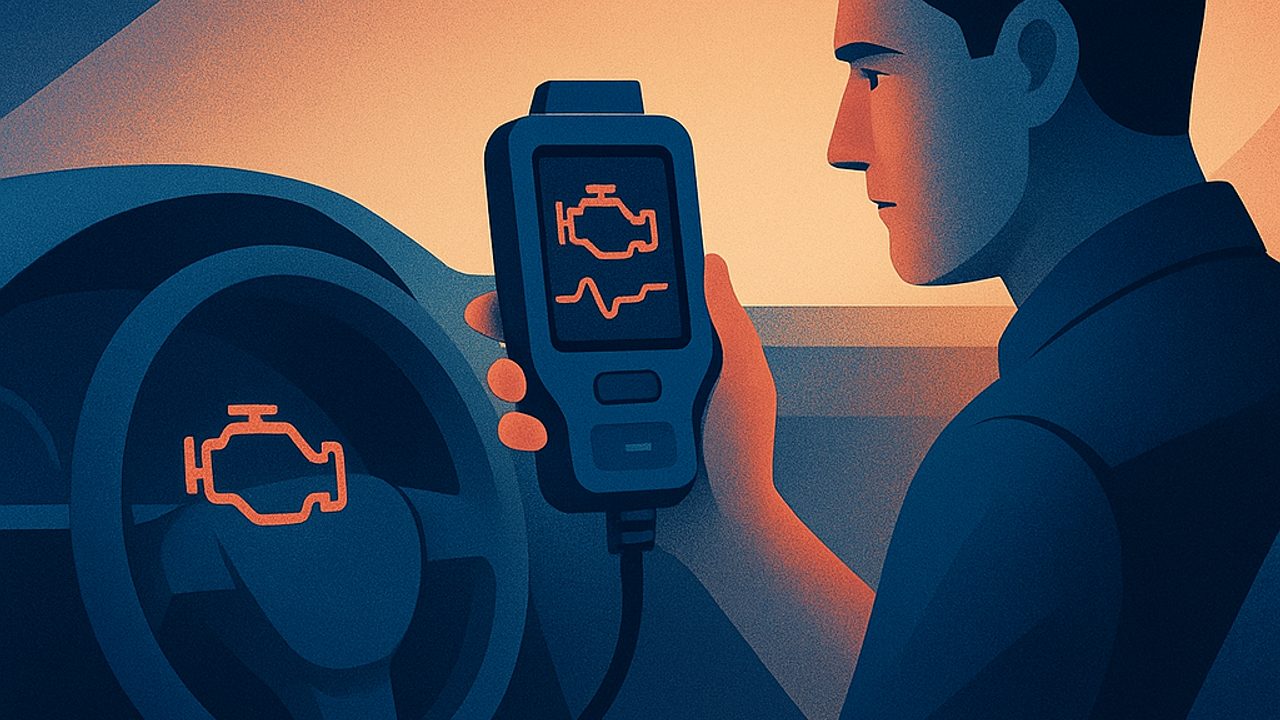
The check engine light comes on, the dashboard fills with acronyms, and curiosity takes over. The OBD2 automotive scanner has become a common item: affordable, portable, and connected to your phone. It does help — as long as it’s used carefully.
The key point is separating information from diagnosis. A code is not a sentence. It’s a clue. Reading it properly avoids scares, unnecessary expenses, and rushed decisions behind the wheel.
What OBD2 is and why your car talks to it
OBD2 is a diagnostic standard that allows access to data from the vehicle’s control unit. It monitors emissions, engine, transmission, and various sensors. When it detects something outside the expected range, it records a code and often turns on a warning light on the dashboard.
In practice, OBD2 is used to:
- Identify faults recorded by the control unit - Monitor real-time data (temperature, RPM, battery voltage) - Clear codes after a repair (with discretion) - Help decide the next step with more information
It’s not a “miracle” tool. It’s a thermometer of what the control unit noticed — not a complete diagnosis of the car.
Types of scanners: from simple to more complete
There are three common categories on the market:
- **Basic readers**: display codes and clear faults. They do the basics. - **Scanners with apps**: connect via Bluetooth and show live data, graphs, and history. - **Advanced equipment**: access specific modules, active tests, and service functions.
For home use, the first two already help a lot. The limitation appears when the fault involves specific modules (airbag, ABS) or when components need to be tested while operating.
Understanding codes without falling into traps
OBD2 codes follow a standard (e.g., P0301). Each part has a meaning. The common mistake is reading the short description and concluding that a part has “failed.” Not always.
Practical examples:
- **Cylinder misfire** may point to a spark plug, coil, injector, false air intake, or even bad fuel. - **Lean/rich mixture** may indicate a sensor issue, a leak, fuel pressure problems, or adaptation out of range.
Use the code as a **starting point**. Observe symptoms, when it appeared, and whether there are other related codes.
The difference between current and historical faults
- **Current/pending**: the condition is present now or has reappeared recently. - **Historical**: it occurred in the past and has not returned.
Clearing historical codes without investigating can mask an intermittent problem. If it comes back, the clue was already there.
Live data: where the scanner really helps
Real-time numbers help check for consistency:
- Engine temperature rising gradually - Stable idle RPM - Battery voltage within the expected range
Obvious inconsistencies draw attention. For example, a cold engine “reading” as hot, or voltage dropping too much with the car running. Even so, odd data calls for confirmation — sensors and wiring can also fail.
Clearing codes: when it makes sense and when it doesn’t
Clearing the code doesn’t fix the car. It makes sense when:
- The cause was temporary (bad fuel, loose gas cap) - The repair has already been done and you want to confirm whether the alert returns
Avoid clearing when:
- The light indicates a critical fault - The car’s behavior has changed (loss of power, jerks, overheating) - There are active safety codes (brakes, airbag)
Driving with “clean” codes does not guarantee everything is fine.
Situations where the scanner falls short
Some problems stay outside the OBD2 radar:
- Mechanical noises - Physical wear of parts - Small leaks - Faults under specific load conditions that don’t generate a code
In addition, active tests and measurements with dedicated instruments are often needed to close a diagnosis.
When it’s time to look for a mechanic
Use the scanner as a screening tool. Seek help when:
- The light returns after clearing - There is more than one related code - The car enters limp mode - The problem affects brakes, steering, airbag, or stability
Bringing the noted codes, symptoms, and when they occur helps the professional save time and focus on the right point.
Final tip: information in the right measure
OBD2 is an ally of the attentive driver. It informs, guides, and avoids guesswork. But careful interpretation is what turns data into safe decisions. Between curiosity and diagnosis, choose careful observation — and a car in good condition to drive.
Comments
Comments are public and the sole responsibility of the author. Don’t share personal data. We may store technical signals (e.g. IP hash) to reduce spam and remove abusive, illegal, or off-topic content.