
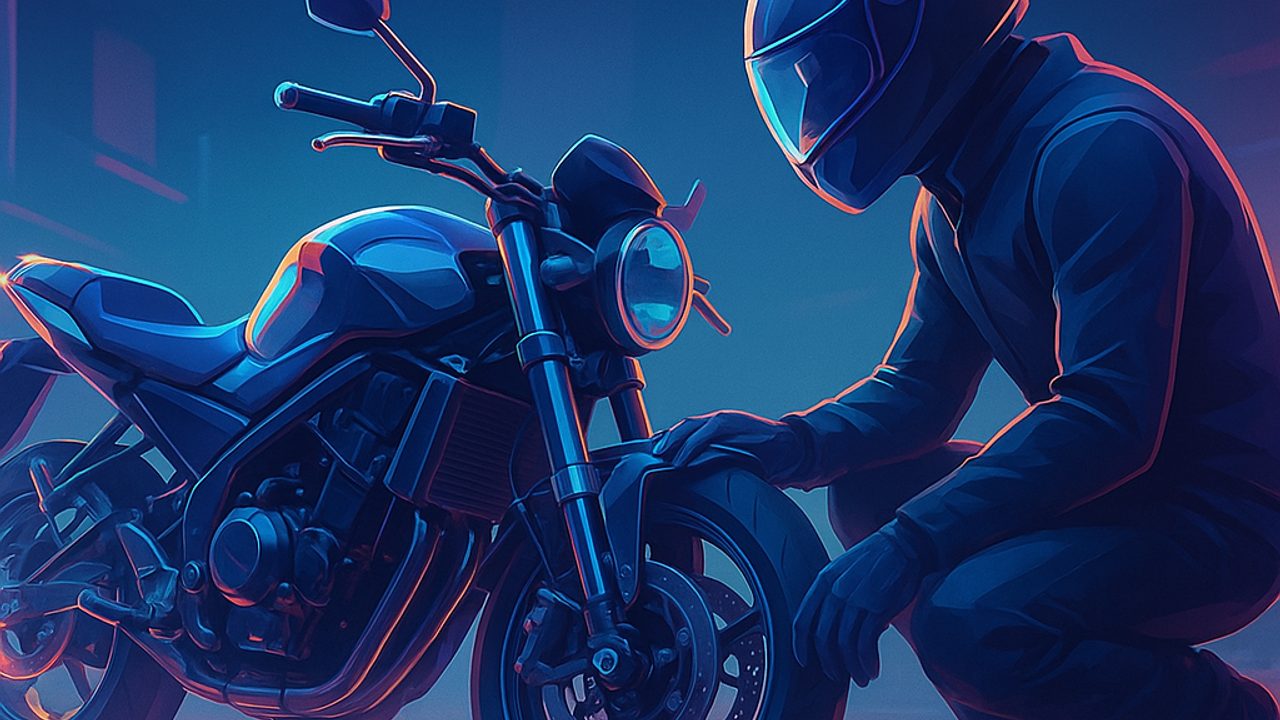
Falls happen — especially in the beginning. Sometimes it’s a silly tip-over at low speed; other times it’s a slip that scares more than it hurts.
Before riding off as if nothing happened, it’s worth doing a quick and objective check. Small damage can go unnoticed and turn into a risk just a few kilometers later.
Your body comes first: stop and check yourself
Before looking at the bike, look at yourself.
- Pain that increases over time, dizziness, or difficulty moving call for a pause. - Torn gloves, jacket, or pants indicate a stronger impact than it seemed. - If there’s any doubt, don’t ride. The bike can wait; your body can’t.
Handlebar, triple clamp, and overall alignment
With the bike turned off, stand in front of it.
- The handlebar should be straight when the front wheel is straight. - Turn the handlebar side to side: the movement must be smooth, without binding. - If the bike “pulls” to one side when pushing it, there may be misalignment.
A stationary fall often bends the handlebar easily, even without obvious marks.
Brakes and levers: immediate response
Squeeze the levers while stopped.
- The brake lever should not touch the grip. - The response must be firm, without sinking too much. - The rear brake pedal must not be bent or scraping.
Watch for leaks
- Look for fluid dripping near the calipers or hoses. - Any brake fluid leak is a reason not to ride.
Wheels, tires, and suspension
Here the risk is silent.
- Check for dents in the rim or cuts in the tire. - See if the wheel spins freely, without wobbling side to side. - Compress the suspension: it should move up and down without clicks or binding.
A leaking suspension or damaged tire doesn’t go with “just to get home.”
Controls and foot pegs in the right place
Falls usually hit what sticks out the most.
- Foot pegs should fold and return normally. - The gear lever and brake pedal must not be bent to the point of hindering use. - The throttle must snap back on its own when you release it.
A sticking control is an invitation to a scare at the first intersection.
Engine, exhaust, and strange noises
Start the bike and listen.
- New, metallic noises or different vibrations deserve attention. - Check for a strong fuel smell or smoke outside the normal range. - A very bent exhaust can touch the swingarm or other parts.
If something “doesn’t sound right,” trust your intuition and stop.
Lights, turn signals, and mirrors
Being seen is also safety.
- Test the headlight, tail light, brake light, and turn signals. - Mirrors should allow adjustment and not rotate on their own.
A light fall can easily break a bulb — and riding invisible increases risk.
When in doubt, don’t ride
For those just starting out, the rule is simple: if you feel unsure, don’t go.
Pushing the bike, asking for help, or calling transport is cheaper than dealing with another fall caused by something that went unnoticed. Safety, after a spill, starts with the decision to check everything calmly.
Comments
Comments are public and the sole responsibility of the author. Don’t share personal data. We may store technical signals (e.g. IP hash) to reduce spam and remove abusive, illegal, or off-topic content.