
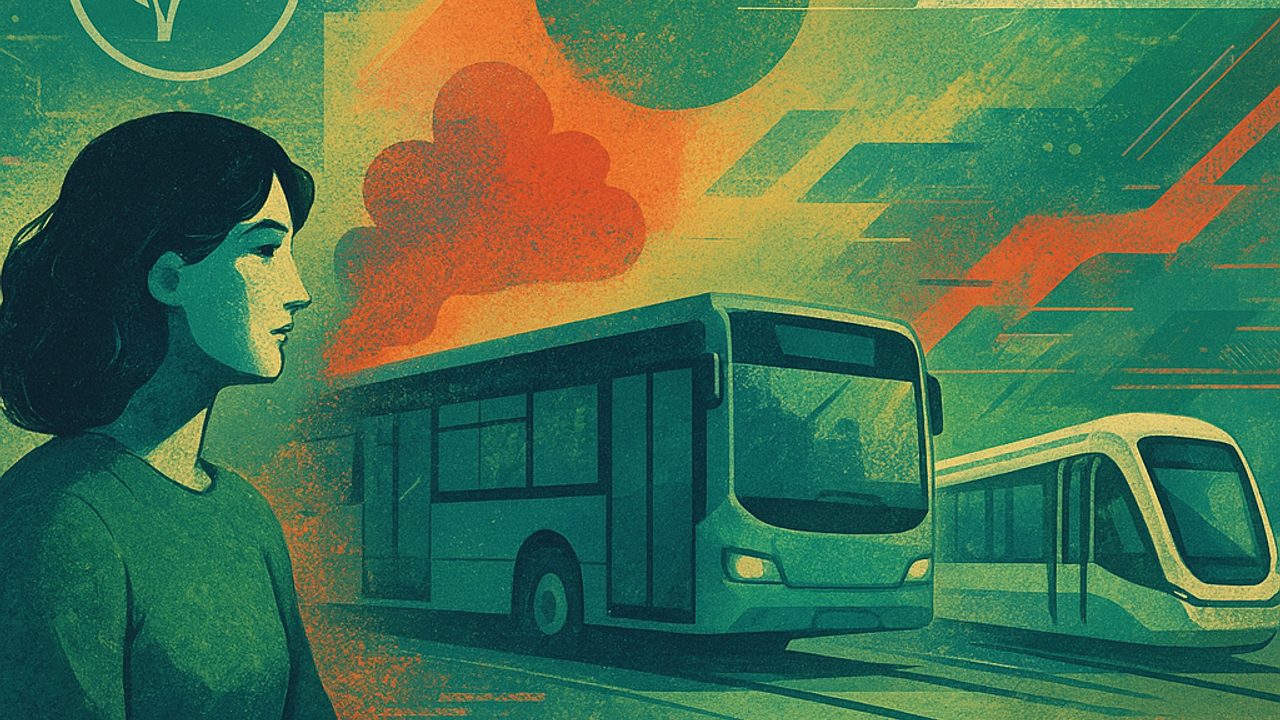
Public transport is almost always cited as an ally of the climate. And on average, it is indeed more efficient than the private car. But this advantage is neither automatic nor guaranteed.
In daily life, simple decisions — timing, occupancy, integration with other modes — can strengthen or weaken this environmental gain. Below are three common pitfalls that distort the comparison and how to escape them without complication.
Pitfall 1: comparing emissions per vehicle, not per passenger
A classic mistake is to look only at the size of the bus or train and conclude that it “pollutes more” because it is large or uses diesel. The correct calculation divides emissions by the number of people transported.
A full bus dilutes the impact per passenger. A car with a single occupant concentrates everything over a few kilometers. When the comparison ignores occupancy, the analysis becomes unfair — and so do the decisions.
**How to avoid it in everyday life:** - Prefer times and routes with good occupancy whenever possible. - Avoid solo car trips on routes where public transport already runs full. - If you use a car, arrange carpools on regular routes to improve the per‑person calculation.
The role of occupancy in climate efficiency
The occupancy rate is a game changer. A nearly empty bus loses much of its environmental advantage. The same applies to trains outside peak hours.
This does not mean that public transport “doesn’t work” outside busy times, but rather that efficiency varies throughout the day. Understanding this variation helps make more informed choices.
Pitfall 2: ignoring the trip to the stop or station
Many people evaluate only the main leg — bus, subway, or train — and forget about access. When the trip to the stop involves a private car, the environmental advantage can shrink considerably.
A short daily car trip to the station adds up in total emissions. In some cases, it cancels out the gains of collective transport.
How to reduce the impact of access
Some simple alternatives make a difference: - Walk or cycle to the stop, even if only for part of the journey. - Use a folding bicycle integrated with public transport. - Prioritize routes with stops closer to home or work, even if the total trip is a bit longer.
These adjustments often reduce emissions without requiring major changes to routine.
Pitfall 3: treating all public transport as the same
Not every system has the same environmental performance. Old diesel buses, poorly maintained vehicles, or routes stuck in congestion emit more than they could.
At the same time, dedicated corridors, electric systems, or renewed fleets make a huge difference in practice. Lumping everything together hides these nuances.
**How to avoid generalizations in everyday life:** - Give preference to dedicated corridors, BRTs, subways, and trains when they exist. - Notice whether a route is usually stuck in traffic; this affects fuel use and emissions. - Value integrations that reduce long transfers and idle time.
When public transport really beats the car
It tends to be more efficient when it combines three factors: - **Good occupancy** (full or nearly full vehicles). - **Smooth operation** (less congestion and unnecessary stops). - **Clean access** (on foot, by bicycle, or micromobility).
When these points align, the reduction in emissions per person is clear — and recurring.
Small adjustments, cumulative impact
In daily life, no one decides public policy or renews entire fleets. But repeated choices add up: - Adjusting departure time to catch a fuller vehicle. - Replacing a short car segment with walking. - Choosing more direct routes, even if they are less “comfortable”.
These details may seem minor in isolation, but over time they help reinforce the role of public transport as a real tool for reducing emissions — and not just a good intention on paper.
Comments
Comments are public and the sole responsibility of the author. Don’t share personal data. We may store technical signals (e.g. IP hash) to reduce spam and remove abusive, illegal, or off-topic content.