
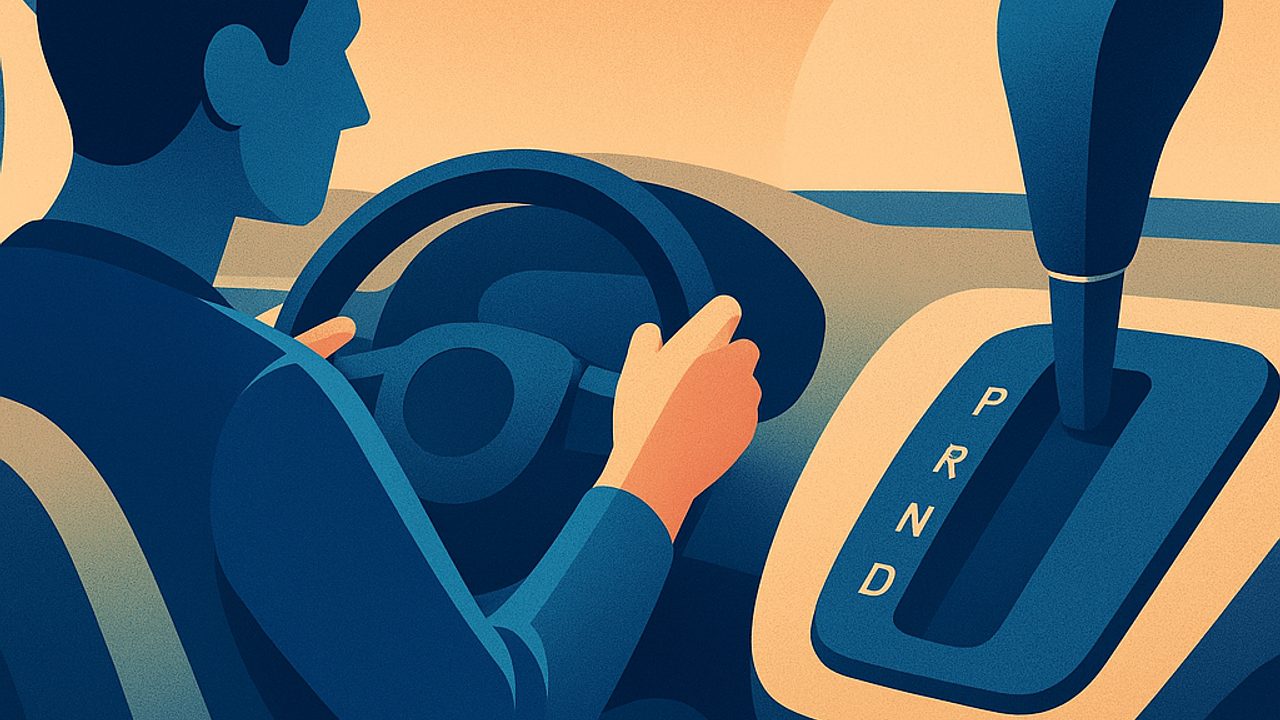
The automatic transmission takes work off the driver, but it doesn’t eliminate the need for attention. For beginners, most problems come from simple habits: stopping, maneuvering, and choosing the wrong mode at the wrong time.
A short checklist helps build safety memory from the first miles. There are three essential items, easy to apply in urban traffic and on the highway.
1) Stops and maneuvers: P, D, and R without rushing
Shifting positions while the car is still moving is a common and dangerous mistake. In an automatic, each letter has a clear function — and respecting that prevents jolts, loss of control, and internal wear.
How to do it the safe way
- **Come to a complete stop** before engaging **R (reverse)** or **P (park)**. - In short maneuvers (garage, parallel parking), use the **brake** to control speed; avoid “modulating” with the accelerator. - When parking on level ground, hold the brake, engage **P**, and only then release the pedal.
2) Hills, descents, and traffic lights: the brake is the protagonist
In an automatic, there is no clutch to “hold” the car. Relying on the accelerator on hills or during long stops increases the risk of unexpected movement.
Habits that increase safety
- On **uphill starts**, keep the car stopped with the **brake**; accelerate only when it’s time to move. - At **long traffic lights**, prefer staying in **D** with the brake pressed; if the stop is very long, **N** can reduce strain, as long as the car is completely stationary. - On **downhill stretches**, use engine braking modes (such as **L**, **S**, or **manual**, if available) to help control speed and save the brakes.
3) Driving modes: less is more for beginners
Modern automatic cars offer several modes. For those just starting out, switching without criteria can confuse the car’s responses and cause unexpected reactions.
Conscious choice of modes
- Use **D** for everyday driving; it’s predictable and safe. - **S (Sport)** responds more quickly to the accelerator — avoid it in heavy traffic or on wet roads. - **Eco** modes help with smoothness, but they don’t replace attention at intersections and during overtaking.
Quick reminders that make a difference
A few extra precautions round out the safety checklist:
- Never engage **P** while the car is moving, not even to “hold it for a moment”. - Don’t accelerate hard right after starting the car; give it a few seconds for everything to stabilize. - If something feels off (jerks, delay in engaging), reduce use and seek technical guidance.
Creating these habits from the start makes driving more predictable, protects the transmission, and, above all, reduces risks in common traffic situations.
Comments
Comments are public and the sole responsibility of the author. Don’t share personal data. We may store technical signals (e.g. IP hash) to reduce spam and remove abusive, illegal, or off-topic content.