
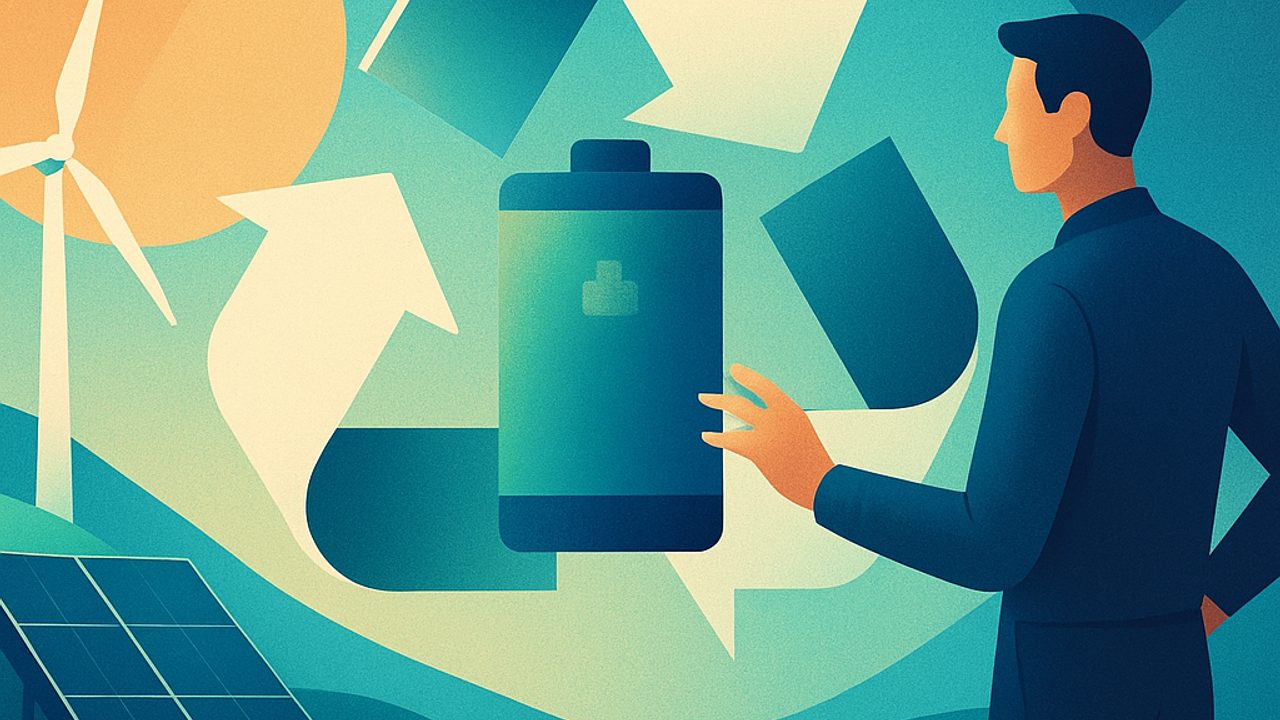
The expansion of solar and wind energy and electric vehicles has put batteries at the center of the conversation. They enable storage, but they also bring a challenge: what to do when they reach the end of their useful life.
In Brazil, battery recycling exists, is evolving, and has clear limits. For those just starting out, it is worth comparing pathways, understanding advantages, and recognizing when recycling makes sense—technically and environmentally.
Why battery recycling matters for renewable energy
Batteries concentrate valuable and sensitive materials. Recovering them reduces pressure on mining, cuts emissions associated with extraction, and prevents improper disposal.
In the context of renewables, recycling helps close the storage loop: less waste, more safety, and better use of resources over time.
Main types of batteries in circulation in Brazil
Not every battery is the same—and this completely changes recycling.
- **Lead-acid**: common in vehicles and older stationary systems. A mature supply chain and high recycling rates. - **Lithium-ion**: present in electronics, electric vehicles, and newer solar systems. Varied technology and more complex recycling. - **Nickel (NiMH, NiCd)**: less common today, still appear in specific applications.
Each type requires distinct processes, with different costs and outcomes.
Pathway 1: lead-acid recycling — the established standard
This is the most resolved case in the country. Logistics are well known, the value of recovered lead supports the process, and the industry already operates at scale.
**Advantages**: - Structured and widespread supply chain - High reuse rates - Lower economic uncertainty
**Limits**: - Technology tied to older batteries - Does not address the growing demand for lithium
For legacy stationary systems, it still makes sense. For new installations, it tends to lose ground.
Pathway 2: lithium-ion recycling — promising, but challenging
These are the batteries growing alongside modern renewables. The challenge is that there is no “standard lithium”: composition varies by chemistry.
What works today
- Recovery of metals such as copper, aluminum, nickel, and, in some cases, lithium - Thermal and chemical processes already operating in the country
Where it stalls
- High cost of collection and processing - Volume still insufficient for full scale - Loss of part of the lithium in some methods
It is an evolving pathway. It works best when there is volume, standardization, and well-organized logistics.
Pathway 3: reuse before recycling — when the battery gets a second life
Not every battery needs to go straight to recycling. In some cases, it can be reused in less demanding applications.
Common examples: - Low-demand stationary storage - Backup systems
**Advantage**: delays disposal and extracts more value from the equipment.
**Limit**: not all batteries are suitable for reuse, and safety control is essential.
When recycling makes sense in Brazil
The answer depends on context.
It makes more sense when: - There is sufficient volume to dilute costs - Collection logistics are organized - The battery type has a market for recovered materials
It makes less sense when: - The battery can still be safely reused - Transport generates more impact than recovery - There is no available technology for that specific chemistry
What to watch as a beginner
For those starting to deal with storage and renewables, a few points help make more realistic decisions:
- The battery type chosen today influences disposal tomorrow - Consolidated supply chains offer less operational risk - Recycling is part of the system, not a standalone solution
Battery recycling in Brazil advances step by step. Understanding its pathways helps integrate renewable energy more coherently—and with less improvisation.
Comments
Comments are public and the sole responsibility of the author. Don’t share personal data. We may store technical signals (e.g. IP hash) to reduce spam and remove abusive, illegal, or off-topic content.