
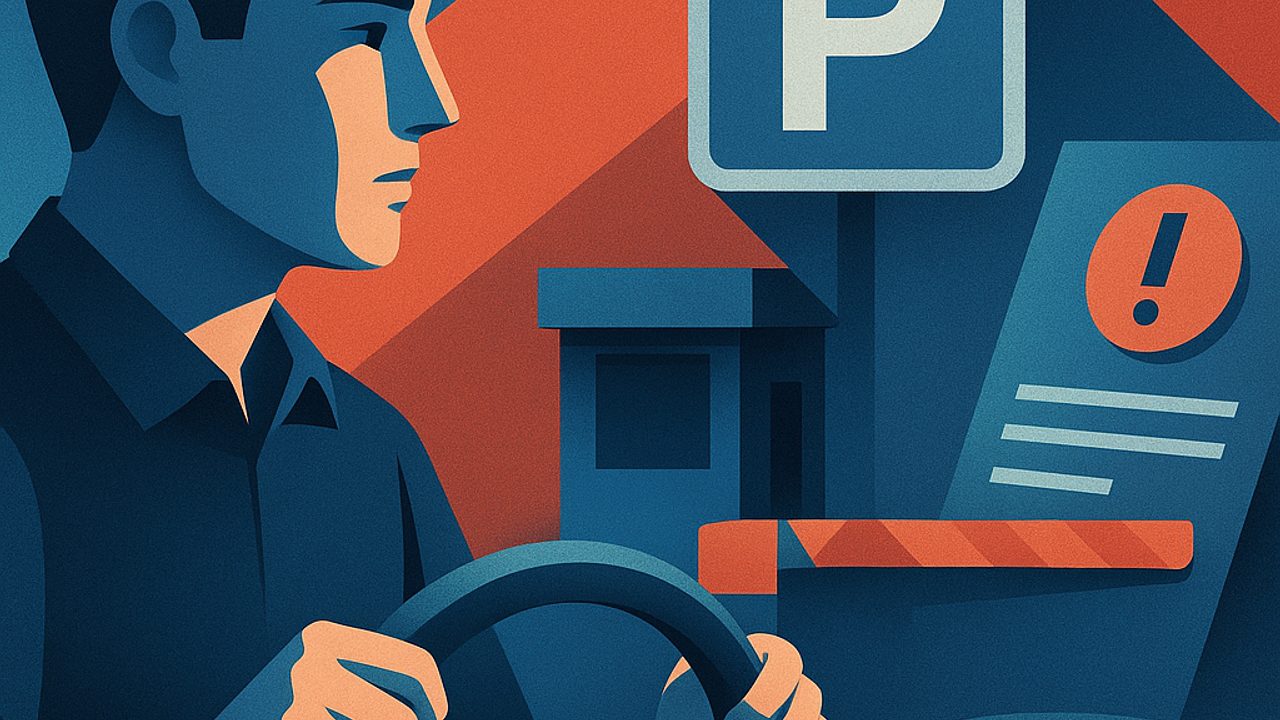
Those who start driving usually calculate fuel, installments, and insurance. The problem is that total cost of ownership (TCO) doesn’t live only on these big items. It grows in repeated details: the “quick” parking, the “cheap” toll, the “unlucky” fine. Separately, they seem harmless. Together, they weigh heavily.
The most common mistake is treating these expenses as exceptions. They are not. For many people, they are part of the routine. Ignoring this distorts any comparison between owning a car, renting, subscribing, or using on-demand transport.
Trap 1: parking treated as occasional
Parking is the champion of invisible costs. R$15 today, R$25 tomorrow, R$40 on the weekend. Before you realize it, it has become a fixed expense without a name in the budget.
Beginners usually make mistakes in two ways:
- They consider only workplace parking, forgetting shopping, gym, appointments, and leisure. - They underestimate the real frequency of car use in paid areas.
How this inflates the total cost
Three days a week paying R$25 already adds up to about R$300 per month. In a year, that’s R$3,600. In the TCO, this amount can be equivalent to a full service or a significant part of insurance.
How to avoid it
- Write down all paid parking for one month, without exception. - Calculate the average monthly cost and treat it as a fixed expense. - Compare with alternatives: monthly passes, rotating days with public transport, or schedule adjustments.
It’s not about stopping using the car, but about knowing how much it really costs when it’s parked.
Trap 2: tolls diluted along the route
Tolls are deceptive because they come in small, spaced-out amounts. R$4 here, R$7 there. For those who use highways frequently, the monthly total is surprising.
The typical beginner’s mistake is thinking only about long trips. But many tolls are part of everyday commutes: work, college, family visits.
When tolls become a structural cost
Someone who passes through two tolls per workday, at R$6 each, spends about R$264 per month. In a year, it easily exceeds R$3,000. This amount completely changes the calculation between living farther away or closer, or between owning a car and alternatives.
How to avoid it
- Map your real routes and identify fixed tolls. - Add up the monthly and annual amounts, without “rounding down.” - Test alternative routes and evaluate the cost in time versus money.
Time also costs money, but you can only decide when the toll number is clear.
Trap 3: fines seen as bad luck
A fine isn’t just about rules. It’s a direct cost in TCO. And for beginners, it usually appears due to distraction, local unfamiliarity, or a rushed routine.
The most common mistakes:
- Parking in places with confusing signage or for longer than allowed. - Driving a few kilometers above the limit “because everyone does it.” - Forgetting rotation days, paid parking zones, or city-specific rules.
The impact goes beyond the fine amount
Beyond the ticket, there are indirect effects:
- Points on the license can increase insurance costs. - Frequent fines distort the perception of the car’s monthly cost.
One or two fines a year are already enough to erase the savings made on fuel or preventive maintenance.
How to avoid it
- Treat fines as a predictable risk item, not an exception. - Review local rules before changing routes or neighborhoods. - Prefer paying for regular parking rather than “risking five minutes.”
The central mistake: looking at isolated expenses, not the whole
Parking, tolls, and fines have something in common: they rarely make it into the initial spreadsheet. Without them, TCO is artificially low.
When these costs show up, it feels like the car “suddenly got more expensive.” It didn’t. It was always that price — it just wasn’t being measured.
Practical checklist to include the invisible costs in TCO
For those starting out, a simple roadmap helps:
- List paid parking per week and multiply by four. - Add up all tolls from a typical week and project them monthly. - Set aside a realistic annual amount for fines, based on your usage and city.
With these three numbers, compare mobility options more honestly. Many decisions change when the total cost appears in full.
Total cost is a habit, not a one-time calculation
TCO isn’t discovered just once. It’s built through constant observation. Invisible costs are the first to slip away, especially for beginners.
When they enter the radar, they stop being traps. They become data. And good data is what helps you decide better — without end-of-month surprises.
Comments
Comments are public and the sole responsibility of the author. Don’t share personal data. We may store technical signals (e.g. IP hash) to reduce spam and remove abusive, illegal, or off-topic content.