
Fuel is that expense that slips by unnoticed. You fill up today, top off tomorrow, and before you know it the month ends more expensive than expected.
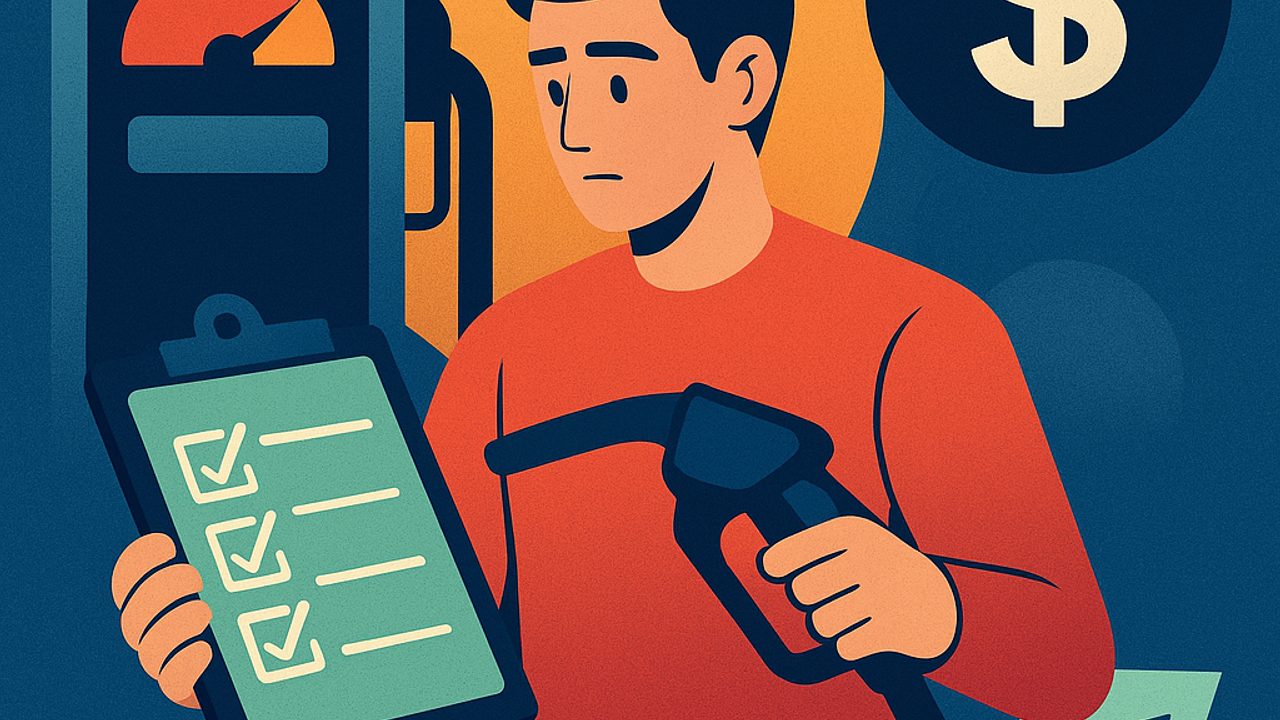
For those just starting to organize a mobility budget, it’s worth treating fuel as a recurring fixed cost. A simple checklist already changes perception — and the impact on your wallet.
1) Set a reference consumption (not guesswork)
The first common mistake is calculating fuel only by the price per liter. What weighs on the budget is the real consumption of your usage.
Start with a practical reference:
- Reset the odometer when you refuel. - Drive normally until the next fill-up. - Divide the kilometers driven by the liters added.
This number becomes your baseline. It doesn’t have to be perfect, just consistent. Without it, any price comparison becomes a guess.
Why this matters for your wallet
With an average consumption known, it’s easier to estimate how much each trip costs. A daily 20 km route stops being abstract and starts to have a value in currency.
2) Choose fuel by cost per kilometer, not per liter
A low price at the pump doesn’t always mean savings. What matters is how much you pay to travel the same distance.
In practice:
- Compare how your car performs with each fuel. - Multiply the consumption by the price per liter. - See which one generates the lowest cost per km.
Sometimes the more expensive fuel yields more and ends up being better over the month. Other times, it doesn’t. Without the math, the choice becomes a habit — and expensive habits tend to last.
3) Create a realistic monthly cap for refueling
Without a defined limit, fuel becomes a silent drain on the budget. A monthly cap helps spot excess early.
How to set this cap:
- Use your average monthly km. - Apply the calculated cost per km. - Add a small margin for unforeseen events.
The goal isn’t to restrict usage, but to have an alert signal when spending starts to drift from the pattern.
Common mistakes that inflate spending without noticing
Some habits seem harmless, but make fuel more expensive over time:
- Topping off the tank “just in case,” without need. - Ignoring variations in consumption in heavy traffic or short trips. - Mixing fuel types without tracking the impact on efficiency.
None of them breaks the budget on its own. Together, they make a difference.
How to track without complicated spreadsheets
You don’t need sophisticated control. The basics work:
- Write down the date, liters, and amount at each refueling. - Record the dashboard km. - Review the total spent at the end of the month.
In a few cycles, the pattern appears. And when the pattern appears, decisions get cheaper.
Fuel as a recurring cost, not a surprise
Treating fuel as a predictable expense changes the relationship with the car. It stops being an “inevitable” expense and becomes a controllable item.
For beginners, these three points already put fuel under scrutiny — and prevent the budget from being consumed little by little, liter by liter.
Comments
Comments are public and the sole responsibility of the author. Don’t share personal data. We may store technical signals (e.g. IP hash) to reduce spam and remove abusive, illegal, or off-topic content.