
For those just starting out, the chain often goes unnoticed — until the day the bike jerks, makes strange noises, or responds poorly to the throttle. All of this affects safety, especially at low speed and on uneven surfaces.
Taking care of the chain, rear sprocket, and front sprocket is not just about durability. It is about predictability: smoother acceleration, less risk of locking, and consistent motorcycle behavior.
What the drivetrain does and why it affects your safety
The drivetrain transfers engine power to the rear wheel. When the chain is dirty, dry, or poorly adjusted, that power arrives in jolts.
In practice, this can mean: - Jerks when starting off or downshifting. - Delayed throttle response at intersections. - Uneven wear that can lead to chain failure.
For beginners, any of these surprises increases the risk of losing balance.
Warning signs: when something is not right
Pay attention to simple everyday signs: - Continuous metallic noise while riding. - Chain too loose, hitting the swingarm. - Chain too tight, with no visible slack. - Rear or front sprocket teeth that look “sharp” or bent.
If any of these appear, it is worth stopping and checking before continuing to ride.
Chain cleaning: less dirt, more control
Cleaning the chain removes sand and residues that accelerate wear. For urban use, a basic routine already helps a lot.
How to clean without complications
- Use the motorcycle cold and turned off. - Apply a chain-specific degreaser or kerosene. - Scrub with a soft brush, without excessive force. - Rinse lightly and let it dry.
Avoid aggressive products or high-pressure jets, which can damage the seals (on O-ring chains).
Proper lubrication: the key point to avoid jerks
A clean chain needs lubrication to work smoothly.
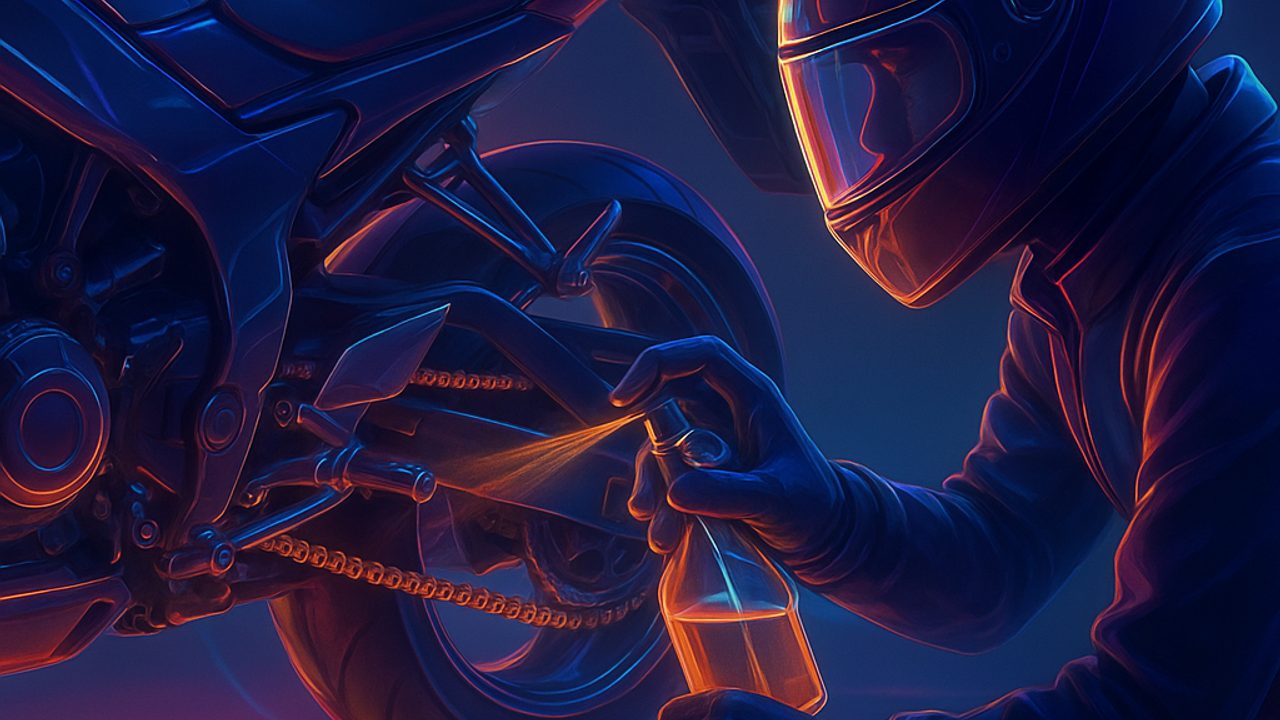
Best practices: - Lubricate after cleaning or after riding, with the chain warm. - Apply the product to the inner side of the chain, slowly turning the wheel. - Avoid excess: too much oil attracts dirt.
A well-lubricated chain reduces noise and makes acceleration more predictable.
Slack adjustment: neither loose nor tight
Correct slack avoids two dangerous extremes: a chain jumping or overstressing bearings.
Simple reference for beginners
- Check the manual for the exact slack measurement. - Always measure at the tightest point of the chain. - Adjust the tensioners on both sides equally.
If the chain becomes stiff when moving the suspension, it is too tight.
When to replace chain, rear sprocket, and front sprocket together
Replacing just one part may seem economical, but it usually leads to accelerated wear.
Signs that the set needs replacement: - Chain at the end of its adjustment range. - Deformed rear or front sprocket teeth. - Frequent adjustments without maintaining proper slack.
A new set runs quieter and more predictably, something valuable for those still building confidence.
Simple habits that increase everyday safety
- Check slack visually every week. - Lubricate at regular intervals, according to use. - Pay attention to new noises. - Avoid hard launches with a dry chain.
These care steps take only a few minutes and help keep the motorcycle gentle, especially in situations where fine control makes a difference.
Comments
Comments are public and the sole responsibility of the author. Don’t share personal data. We may store technical signals (e.g. IP hash) to reduce spam and remove abusive, illegal, or off-topic content.