
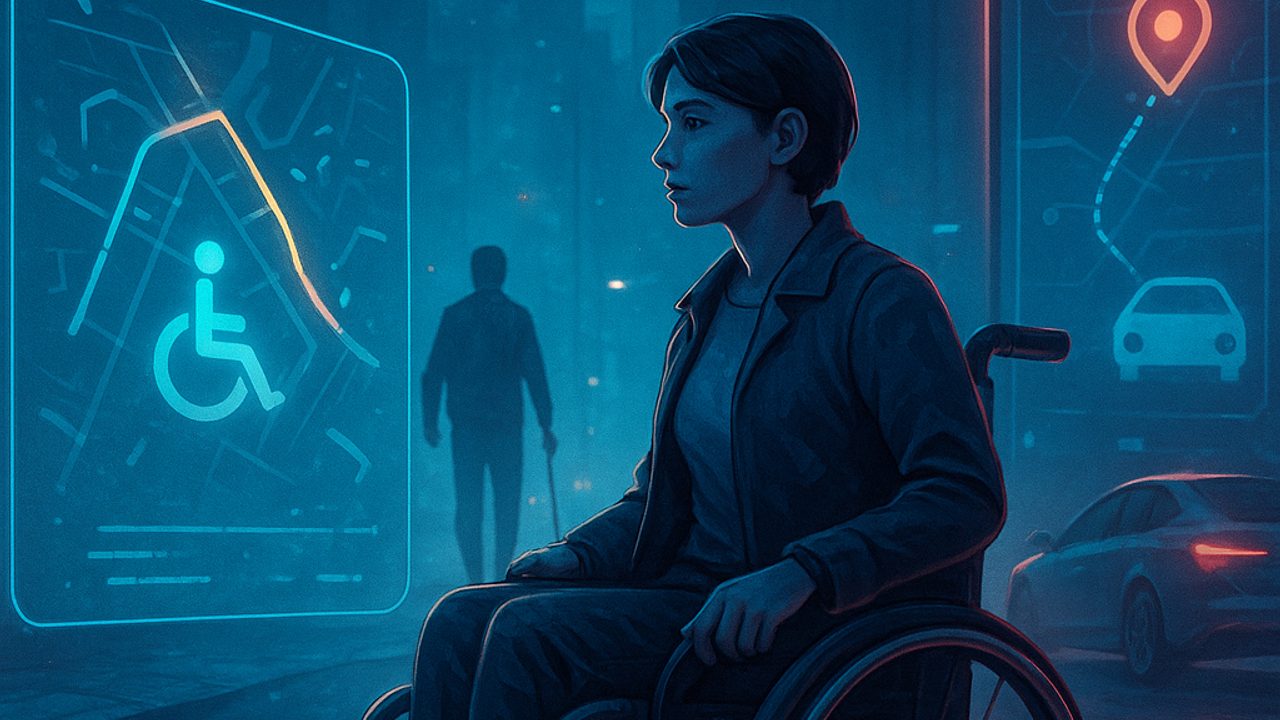
Leaving home already requires planning. For people with disabilities and their families, the journey can be just as important as the destination. A poorly maintained sidewalk, a broken elevator, or incomplete information in an app changes everything.
Having a simple checklist helps reduce unexpected issues and make safer decisions. The idea is not to eliminate all risks, but to choose more friendly routes and combine alternatives.
1) Walking route: sidewalk, crossing, and pace
Before thinking about transport, it is worth carefully looking at the walking segment. Many barriers appear right at the start or in the last few meters.
Practical points to observe:
- **Continuous sidewalks**: uneven surfaces, holes, loose covers, and excessive lateral slope make movement difficult. - **Curb ramps at corners**: check whether they exist on both sides of the street and whether they are obstructed by cars, poles, or trash. - **Crossings**: visible crosswalks, sufficient traffic light timing, and, when available, audible signals.
A slightly longer route with regular sidewalks and predictable crossings is often more accessible than the shortest path.
Quick tip for everyday life
If the route is frequent, observe it at different times. What works in the morning may become impractical at night due to cars on the sidewalk, outdoor seating, or temporary construction.
2) Transport: real access, not just on paper
Buses, subway, trains, taxis, or ride-hailing services enter the planning as stages of the journey, not as automatic guarantees of accessibility.
On the checklist, consider:
- **Accessible stop or station**: platforms at the correct level, functioning elevators, and visible and audible information. - **Boarding and alighting**: the gap between the vehicle and the platform, presence of steps, and operator assistance when needed. - **Plan B**: knowing the next line, station, or option if something does not work.
In Brazil, operational failures happen. Anticipating alternatives reduces stress and waiting time.
3) Apps and technology: verify, don’t trust blindly
Apps help a lot, but they do not always reflect street reality. The digital checklist needs human verification.
Use apps to:
- **Compare routes**: look at more than one option and note where the longest walks or transfers are. - **Read recent comments**: reports from other users often reveal temporary barriers. - **Save critical points**: places where the signal drops, where boarding is difficult, or where there has been a problem before.
Whenever possible, combine the app with your own experience or that of someone you trust.
How to put it all together into a more inclusive route
Accessible planning comes from the sum of the three items: a viable walking route, usable transport, and technology as support. If one fails, the others need to compensate.
A common example: choosing a bus stop a bit farther away because the sidewalk is better and the crossing is safer. Another: preferring a station with a reliable elevator, even if it requires one more transfer.
Inclusion is also about sharing information
When a route works, it can help other people. Sharing information with family members, neighbors, or local groups strengthens inclusion in practice.
Planning accessible routes is not just an individual strategy. It is a way to occupy the city with more autonomy, predictability, and respect for different ways of getting around.
Comments
Comments are public and the sole responsibility of the author. Don’t share personal data. We may store technical signals (e.g. IP hash) to reduce spam and remove abusive, illegal, or off-topic content.