
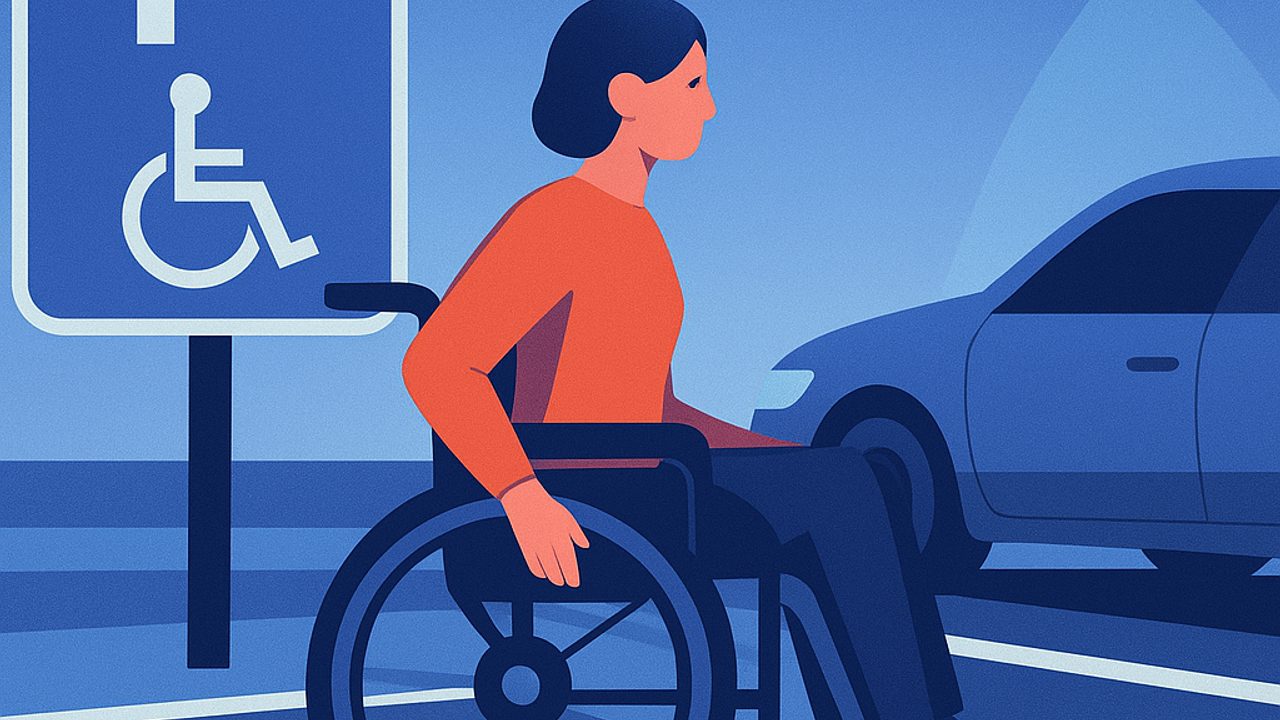
Parking is not just about stopping the car. For people with disabilities, access to the correct space impacts autonomy, safety, and travel time.
This checklist brings together the essentials about PCD parking in Brazil, with a focus on inclusion and respectful coexistence in daily life.
1) Visible and valid credential
The PCD credential is the starting point. It identifies the right to use the space and avoids unnecessary approaches.
- It must be **visible on the dashboard**, with the front facing outward. - It is **personal**, linked to the person with a disability — not to the vehicle. - It is valid in public and private spaces for collective use, when properly signposted.
Attention to details
- Check the **expiration date** and **legibility**. - When traveling or changing cars, remember to take the credential with you.
2) Correct space: signage and dimensions
Not every space “looks” like a PCD space, and not every PCD space is well signposted. Proper use depends on observing the whole setup.
- **Vertical and horizontal signage**: signs and ground markings indicate the reserved space. - **Lateral access aisle**: space beside the spot is essential to open doors, use a wheelchair, or perform transfers. - **Location**: close to accessible entrances, ramps, or elevators.
When the space does not work
- Obstacles, excessive slopes, or lack of a lateral aisle compromise use. - Reporting the problem helps improve the space for everyone.
3) Responsible use: who can use it and when
A PCD space is not a “quick stop” spot. It is an accessibility resource.
- Only use it if **the person with a disability is in the vehicle**, as driver or passenger. - Avoid “lending” the credential, even for a short time. - Respect the **time needed** for boarding and disembarking.
Respect in everyday life: small actions, big impact
Inclusion also happens outside formal rules.
- Do not question someone’s disability; many are not visible. - Avoid judgments or comments when you see someone using the space. - If the space is irregularly occupied, prioritize appropriate channels to report the situation.
For family members and companions
- Decide in advance who will be responsible for the credential. - When parking, think about the **space around**, not just the spot itself. - Support autonomy: offer help, but wait for the response.
Final reminder
PCD spaces exist to ensure access on equal terms. Using them correctly — or respecting them when you are not entitled — is a daily choice that makes the city more fair and accessible.
Comments
Comments are public and the sole responsibility of the author. Don’t share personal data. We may store technical signals (e.g. IP hash) to reduce spam and remove abusive, illegal, or off-topic content.