
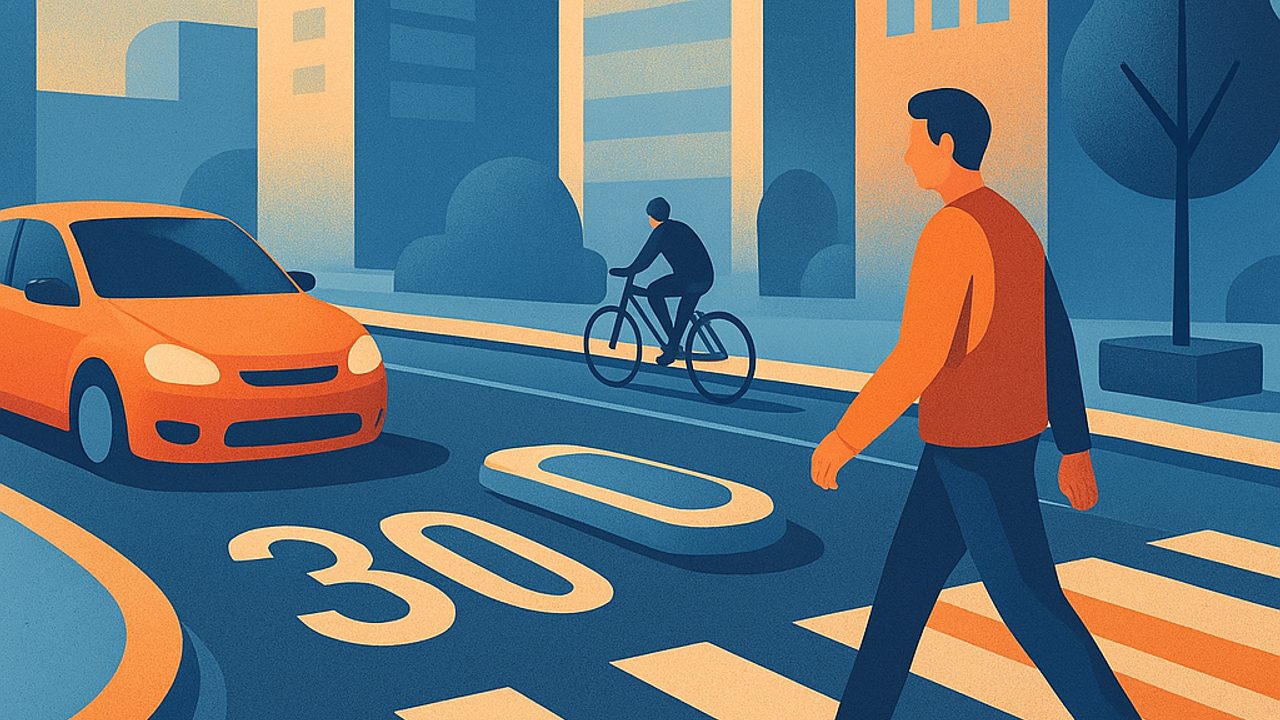
In big cities, most serious crashes happen close to home: local streets, neighborhood shops, areas around schools and stations. It’s not a lack of signs. It’s excessive speed where space is contested.
30 Zones and traffic calming tackle this issue. They don’t rely on one-off campaigns; they change the street design to induce safer behavior.
What a 30 Zone is—and what it is not
A 30 Zone is an urban area where the maximum speed is 30 km/h, applied continuously, with coherent signage and street design. It is not an isolated segment or a lone sign on a pole.
The main goal is to reduce the severity of impacts. At 30 km/h, the driver’s field of vision is wider, braking distance is shorter, and the risk of pedestrian death drops dramatically.
Traffic calming: less speed by design, not just by rule
Traffic calming brings together physical interventions that “calm” traffic. Instead of asking for caution, the street comes to demand it.
Common measures: - Visual narrowing of the roadway - Gentle curves and chicanes - Raised crossings and intersections - Center islands and refuges - Differentiated paving in shared areas
When well combined, these solutions reduce average speed without choking circulation.
Where it makes the most sense in big cities
30 Zones work best in areas with a high mix of uses and a strong presence of people walking or cycling: - Residential neighborhoods with local commerce - Areas around schools, daycare centers, and health facilities - Neighborhood centers and streets accessing stations - Local streets that receive unwanted through traffic
On arterials and bus corridors, the logic is different. A common mistake is trying to “spread” 30 Zones without hierarchizing the road network.
Design elements that make a difference
The coherence of the whole matters more than the strength of any single item.
Corner design and crossings
- Smaller curb radii force slower turns - Raised crossings place pedestrians in the driver’s field of vision - Sidewalk alignment reduces crossing distance
Clear street legibility
- Narrower lanes communicate a lower desired speed - Street furniture and trees create lateral “walls” - Continuous pavement indicates priority for those crossing
Road safety: why 30 km/h changes the game
The physics is simple: energy grows with the square of speed. In crashes, a few kilometers per hour make an enormous difference.
Observed effects in areas with well-implemented 30 Zones: - Fewer crashes and, above all, fewer serious injuries - More predictable coexistence between modes - Reduced noise and a greater sense of safety
It’s not just pedestrian protection. Drivers also benefit from less severe conflicts.
Enforcement and communication: support, not a crutch
Enforcement helps, but it does not replace design. When the street “asks” for 30 km/h, compliance is spontaneous.
Good practices include: - Entry signage and repetition within the area - Consistent pavement markings - Simple communication with residents and shopkeepers
Avoid contradictory messages: isolated speed humps on wide roadways confuse drivers and create stop-and-go behavior.
Common mistakes that undermine results
Some pitfalls repeat themselves: - Implementing 30 Zones without treating intersections - Keeping lanes too wide and too straight - Creating exceptions that become the rule - Overlooking local loading and unloading needs
Traffic calming is urban design, not a patch. When conceived as a system, the city moves better—and people get home.
Comments
Comments are public and the sole responsibility of the author. Don’t share personal data. We may store technical signals (e.g. IP hash) to reduce spam and remove abusive, illegal, or off-topic content.