
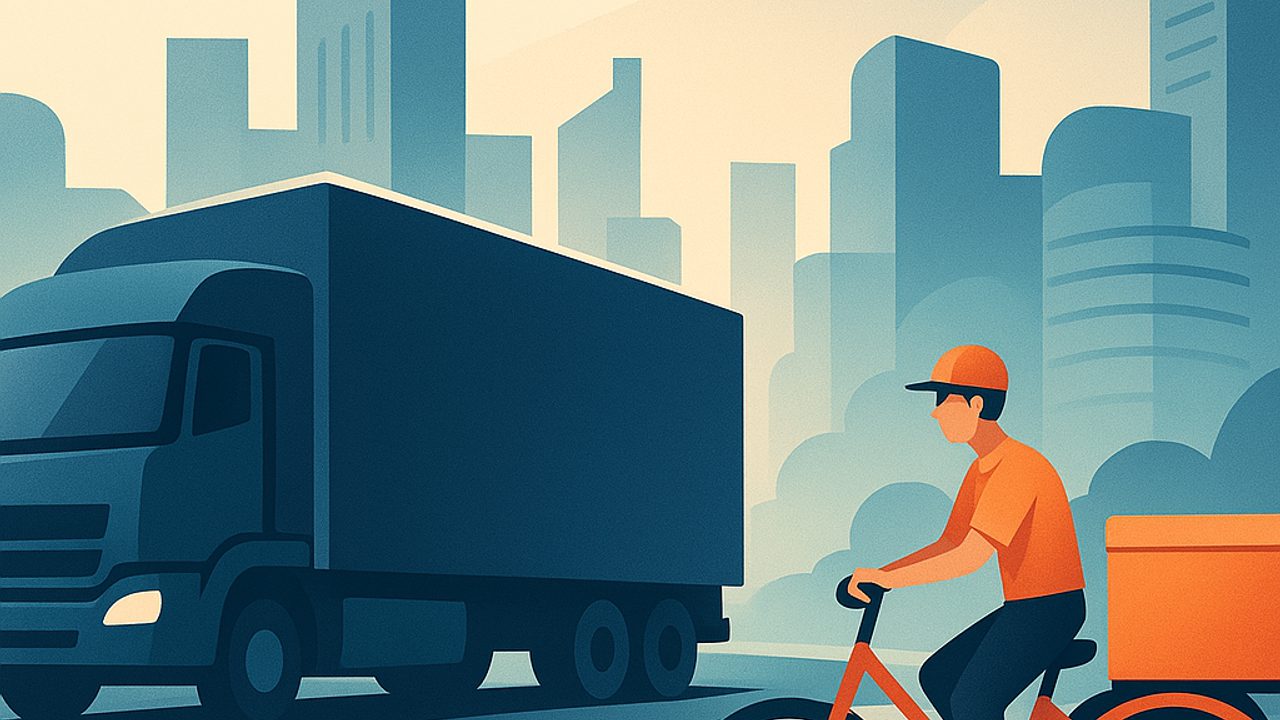
Urban logistics and the last mile are often treated as synonyms, but they are not. In practice, each addresses different challenges of the urban environment — especially when safety enters the equation.
Comparing the two models helps decide when to centralize operations, when to disperse deliveries, and how to reduce risks for people, cargo, and vehicles in the city’s daily routine.
What urban logistics is (and where safety matters)
Urban logistics organizes supply flows within the city, from the distribution center to intermediate points such as stores, urban hubs, or lockers. The focus is on planning, predictability, and control.
From a safety standpoint, it stands out for:
- More stable and recurring routes - Larger vehicles, but less exposed to frequent maneuvers - Delivery windows planned to avoid critical times
The limitation appears when the city is dense and unpredictable: congestion, restricted areas, and conflicts with pedestrians can increase operational risk.
What characterizes the last mile in the urban context
The last mile covers the final stretch to the recipient. It is where the operation encounters narrow sidewalks, bike lanes, crossings, quick stops, and high interaction with people.
In terms of safety, it involves:
- Greater exposure to low-speed accidents - Frequent stops and risk of door opening - Use of light modes (motorcycle, bicycle, on foot), which are more vulnerable
The advantage is flexibility; the limitation is the complexity of the urban environment in real time.
Direct comparison: advantages and limits with a focus on safety
When placing the two models side by side, clear differences emerge:
- **Urban logistics**: more control, less improvisation, less direct interaction with pedestrians - **Last mile**: more agility, but greater dependence on safe driver behavior - **Predominant risk**: operational in urban logistics; behavioral in the last mile - **Incident response**: more structured in urban logistics; more immediate in the last mile
This comparison helps define where to invest in training, technology, and standardization.
When urban logistics makes more sense in the city
Urban logistics tends to be more suitable when:
- There are consolidated volumes and predictable destinations - The city offers defined loading and unloading zones - It is possible to operate outside traffic peaks
Safety points of attention
Even in this scenario, it is worth observing:
- Safe access to loading areas - Visibility during maneuvers of larger vehicles - Clear communication between drivers and yard operators
When the last mile is the most viable choice
The last mile makes sense when demand is dispersed and response time is critical. In dense residential areas, it is often unavoidable.
To maintain safety:
- Prioritize routes with less modal conflict - Plan stops that do not block sidewalks - Reduce haste and improvisation, the main triggers of incidents
Here, small operational decisions have a direct impact on urban safety.
Hybrid strategies: combining models to reduce risks
Many urban operations work best by combining urban logistics and last mile. Intermediate hubs reduce final distances and distribute risks.
Best practices include:
- Transferring only the necessary stretch to light modes - Defining clear transshipment criteria - Standardizing safety procedures among different teams
Safety as a selection criterion, not a final adjustment
Choosing between urban logistics and last mile is not just a cost or speed decision. It is a decision about coexisting with the city.
When safety is considered from the operation’s design stage, the limits of each model become clearer — and the advantages appear with fewer conflicts, less improvisation, and more predictability in urban use.
Comments
Comments are public and the sole responsibility of the author. Don’t share personal data. We may store technical signals (e.g. IP hash) to reduce spam and remove abusive, illegal, or off-topic content.