
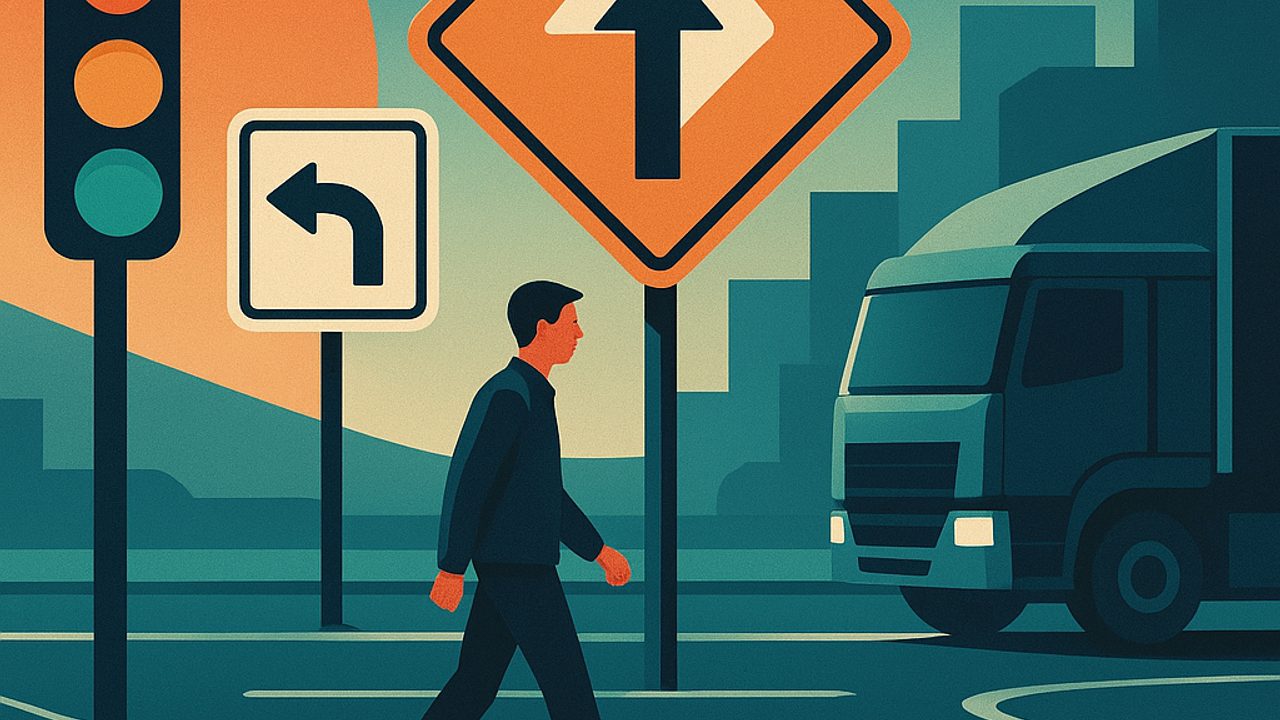
Crooked signs, faded markings, and signals that contradict each other become noise. On busy roads, that noise costs reaction seconds — and seconds turn into accidents.
Treating signage as a system, not as an isolated piece, changes the game. Below are three simple habits, applicable to day-to-day urban management, that make a real difference in road safety.
1) Standardize to reduce doubt, not to “beautify”
Standardization is not aesthetic; it is predictability. When colors, typography, sizes, and positions repeat, the brain recognizes them quickly and decides better.
Best practices for standardization in large cities:
- **Signs at the same height and alignment** along the road corridor, avoiding a “hunt for the sign”. - **Consistent colors and symbols** between neighborhoods, including in areas with frequent construction. - **Clear hierarchy**: what is a priority appears first in the visual field.
Where this matters most
On corridors with multiple modes (buses, bicycles, pedestrians, and freight), standardization prevents conflicting interpretations. A common example is the right turn: when the design repeats, the driver understands the expected maneuver before reaching the intersection.
2) Keep markings visible year-round, not only after resurfacing
A faded line is the absence of a rule. On rainy days, at night, or with heavy traffic, pavement markings become the primary reference.
Habits that work:
- **Repainting schedules based on wear**, not only on fixed dates. - **Paints and materials suited to traffic volume**, especially in bus corridors. - **Post-work review**: any intervention should end with restored horizontal signage.
Crossings are a priority
Well-marked zebra crossings, visible stop lines, and painted islands guide the driver’s eye and give confidence to those crossing. Without this, pedestrians hesitate — and hesitation increases risk.
3) Treat maintenance as a routine, not as a response to complaints
A sign hidden by branches, graffiti on a signal, a rusted support. Taken alone, they seem like small problems. Together, they break trust in the system.
An effective habit is **periodic sweeping**:
- Quick inspections by segment, with simple checklists. - Immediate low-cost fixes (cleaning, pruning, tightening). - Scheduled replacement of critical signs before they lose legibility.
Details that anticipate decisions
Good signage anticipates what comes next. Arrows on the pavement before the intersection, advance warning signs, and channelization markings prevent abrupt lane changes.
On urban expressways, this anticipation reduces hard braking and space disputes — two classic triggers of rear-end collisions.
When signage speaks with its surroundings
It is not enough to be correct in the manual; it needs to dialogue with the context. Intense commerce calls for visual reinforcement. A nearby school changes priorities at specific times. Temporary works require clear reading from afar.
Signage that “speaks” considers:
- Real flows, not just the original design. - Peak hours and seasonal uses. - Those on foot, by bicycle, motorcycle, bus, or truck.
Road safety is an accumulated habit
In large cities, risk does not arise from a single mistake, but from the sum of small failures. Standardizing, keeping visibility, and caring for maintenance are not grand actions — they are routines.
When these routines become habits, signage stops being background and fulfills its role: organizing coexistence and allowing room for safe decisions, even on the most chaotic days.
Comments
Comments are public and the sole responsibility of the author. Don’t share personal data. We may store technical signals (e.g. IP hash) to reduce spam and remove abusive, illegal, or off-topic content.