
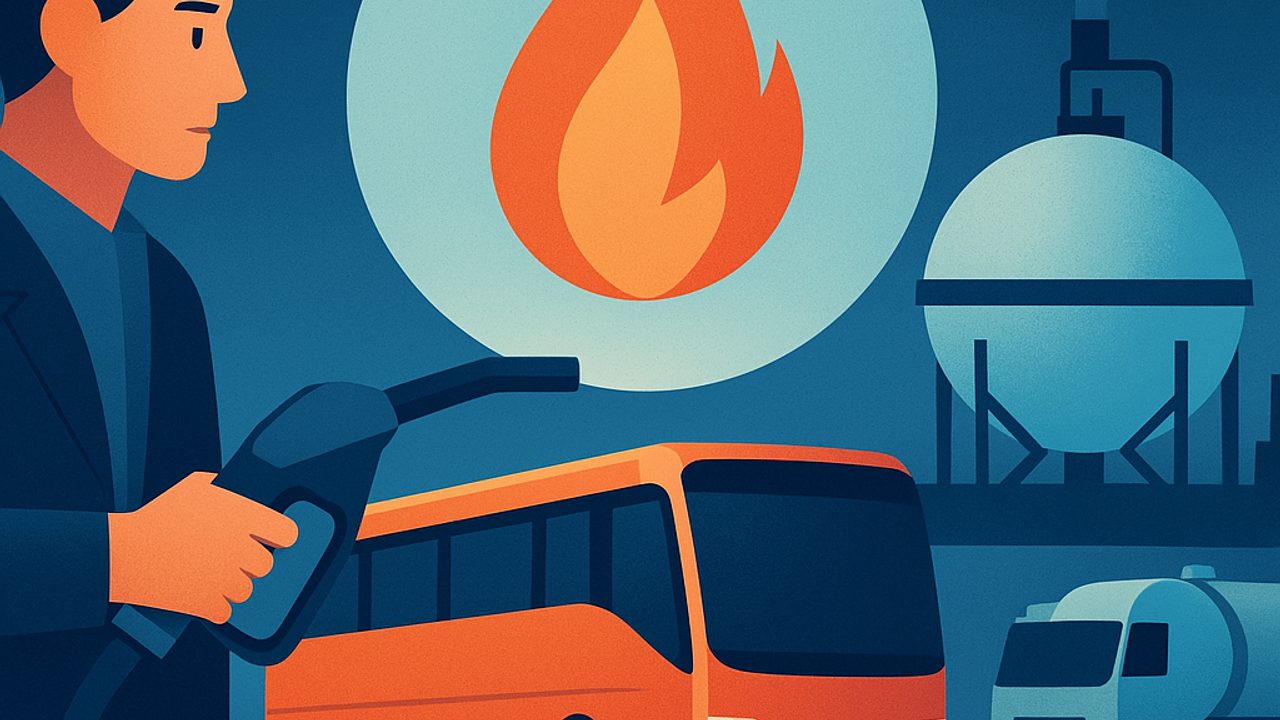
Natural gas often enters the conversation when fuel prices tighten or when the debate is about logistics, fleets, and industry. But the topic quickly becomes confusing: similar acronyms, generic promises, and little practical explanation.
In real life, CNGV, CNG, and LNG solve different problems — and also create others. Understanding where each one makes sense helps avoid frustration, poorly calculated investments, and expectations that do not match the Brazilian reality.
What changes between CNGV, CNG, and LNG — without technobabble
The main difference is not the gas itself, but how it is stored and transported.
- **CNGV (Compressed Natural Gas for Vehicles)**: compressed gas, used mainly in cars and light utility vehicles. - **CNG (Compressed Natural Gas)**: the same principle as CNGV, but applied to fleets, buses, and operations outside the pipeline network. - **LNG (Liquefied Natural Gas)**: gas cooled until it becomes liquid, taking up less volume and enabling long distances.
In practice, this defines cost, range, infrastructure, and where each option can operate.
CNGV in everyday use: where it delivers value
CNGV is the best known in Brazil, especially in urban centers with a distribution network.
It works best when: - The vehicle drives a lot and always returns to the same area. - There are CNGV stations along the usual route. - The driver accepts a loss of trunk space.
Clear limits: - Shorter range compared to gasoline or ethanol. - Total dependence on the station network. - Poorly done conversions compromise performance and maintenance.
That is why CNGV makes sense for taxis, ride-hailing drivers, and light urban fleets. For occasional use or long trips, it often disappoints.
CNG: a niche solution for fleets and regions without pipelines
CNG appears less for the average consumer, but it is relevant in specific operations.
It is used when: - There is no pipeline at the point of consumption. - The operation is concentrated (garage, yard, fixed route). - The fleet is medium or heavy.
Practical advantages: - No need for pipeline construction. - Can fuel buses, trucks, and industrial equipment.
Limitations: - Costly logistics to transport cylinders. - Lower energy efficiency over long distances. - Limited scale: it does not handle large volumes.
In Brazil, CNG is usually an intermediate solution, not a final destination.
LNG: where natural gas starts to compete with diesel
LNG changes the game because it allows natural gas to be transported thousands of kilometers with less volume.
It makes sense when: - The operation is long-haul. - Consumption is high and continuous. - There is dedicated fueling infrastructure.
Strengths: - Greater range for heavy trucks. - Lower local emissions compared to diesel. - Enables routes where pipelines do not reach.
Barriers in Brazil: - Few logistics corridors prepared. - High investment in trucks and cryogenic tanks. - Supply chain still under development.
Today, LNG advances more in pilot projects and captive fleets than in the open market.
Infrastructure: the real bottleneck of natural gas
On paper, natural gas is competitive. On the map, not always.
In Brazil: - The pipeline network is concentrated in the Southeast and parts of the South. - CNGV stations are uneven across states. - CNG and LNG depend on dedicated logistics and careful planning.
This explains why the same gas can be viable in one city and unviable 300 km away.
When natural gas makes sense — and when it does not
It works best when: - There is predictability of route and consumption. - The fleet is dedicated and well sized. - Infrastructure already exists or is shared.
It loses ground when: - Use is occasional. - The operation requires full fueling flexibility. - Logistics costs outweigh the fuel savings.
In Brazil, natural gas is not a universal solution. It is a specific tool for specific problems.
The key point: choose based on use, not on promises
CNGV, CNG, and LNG do not compete with each other — each occupies a distinct space. The common mistake is trying to fit natural gas into any scenario.
When the choice respects the type of vehicle, the route, and the available infrastructure, gas delivers efficiency. Outside of that, it becomes a headache. In oil and gas, the practical decision almost always matters more than the polished speech.
Comments
Comments are public and the sole responsibility of the author. Don’t share personal data. We may store technical signals (e.g. IP hash) to reduce spam and remove abusive, illegal, or off-topic content.