
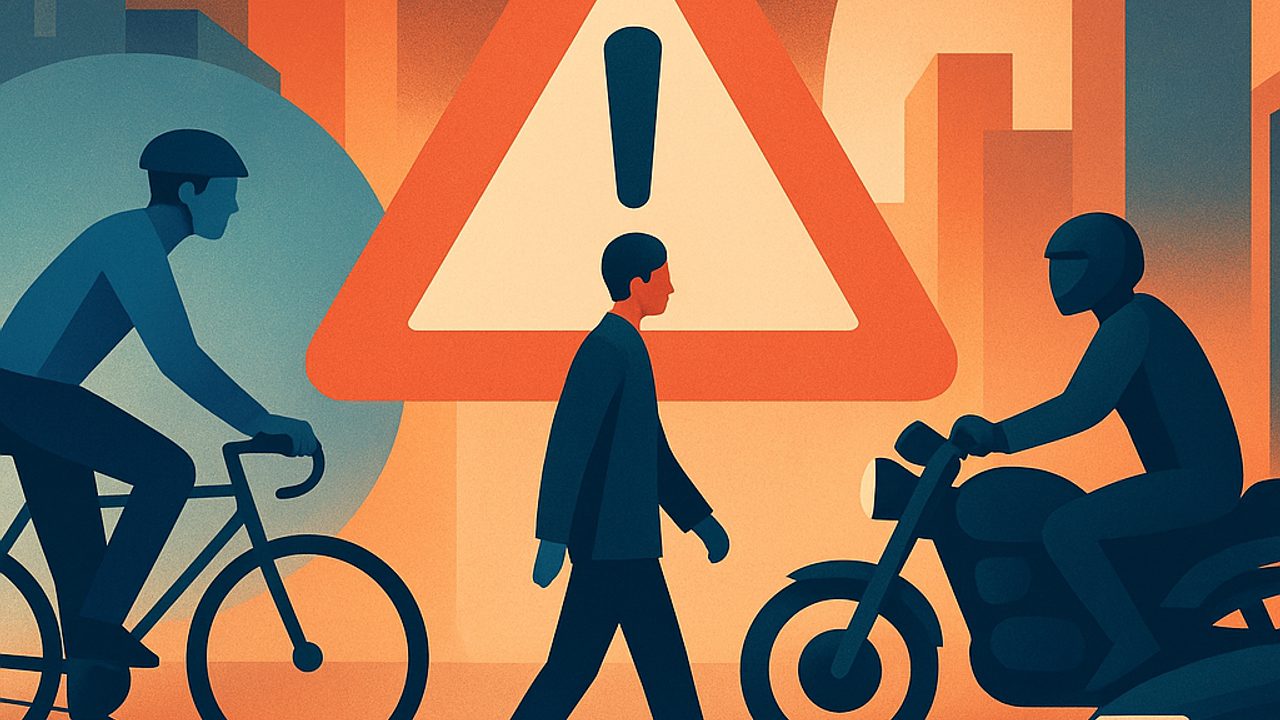
Urban road safety is surrounded by repeated ideas that often do not hold true in practice. Some provide a false sense of protection; others are underestimated, despite consistently reducing risks.
Separating myths from truths is an important step toward more conscious decisions in urban travel, especially in environments with heavy traffic, multiple modes, and frequent conflicts.
Myth: urban accidents are inevitable
The idea that urban traffic is chaotic by nature leads many people to accept risky situations as “normal.” In practice, a large part of incidents is linked to predictable behaviors and recurring critical points.
Truth: risk patterns can be anticipated
Poorly signposted intersections, peak hours, competition for space, and excessive speed on local roads are known factors. Recognizing them helps adopt simple actions, such as reducing speed before intersections and increasing attention in areas with high pedestrian flow.
Myth: only fast vehicles are dangerous
It is common to associate risk only with cars or motorcycles at high speed. This ignores frequent conflicts involving slow vehicles, bicycles, scooters, and even distracted pedestrians.
Truth: speed difference is a critical factor
Conflicts arise when road users have different expectations of movement. In the urban environment, predictability matters as much as speed. Signaling maneuvers, maintaining stable trajectories, and respecting others’ space reduce risks even at low speeds.
Myth: knowing the route well eliminates risk
Traveling the same streets all the time can generate overconfidence. Familiarity, instead of protecting, can lower the level of attention.
Truth: the urban context changes every day
Construction, detours, loading and unloading, changes in flow, and occasional increases in pedestrian volume alter the scenario. Maintaining a defensive posture, even on familiar routes, is one of the most consistent road safety practices.
Myth: signage solves everything
Signs, markings, and traffic lights are essential, but they do not guarantee safe behavior on their own.
Truth: active reading of the environment is indispensable
In addition to signage, it is worth observing: - The intentions of other road users - Parked vehicles that may conceal pedestrians - Atypical behaviors, such as unexpected turns
Attention to the surroundings complements formal signage.
Myth: safety is only the driver’s responsibility
This view ignores the diversity of users in urban space.
Truth: urban road safety is shared
Pedestrians, cyclists, drivers, and public transport operators influence the level of risk. Some attitudes that help collectively: - Pedestrians avoiding crossing outside visible locations - Cyclists maintaining a predictable position on the road - Drivers respecting limits and priority areas
Little-discussed truth: small choices reduce conflicts
It is not only major works or technologies that make a difference. In everyday urban life, simple choices accumulate a positive effect: - Adjusting schedules to avoid peaks when possible - Preferring calmer streets, even if slightly longer - Reducing haste in sections with mixed use
These decisions do not eliminate risks, but they help reduce them consistently.
Urban road safety beyond myths
Understanding what truly contributes to safety in urban traffic allows people to move with greater awareness and less exposure to conflicts. In dense cities, reducing risks depends less on ready-made formulas and more on continuous attention to the environment, to others, and to one’s own travel choices.
Comments
Comments are public and the sole responsibility of the author. Don’t share personal data. We may store technical signals (e.g. IP hash) to reduce spam and remove abusive, illegal, or off-topic content.