
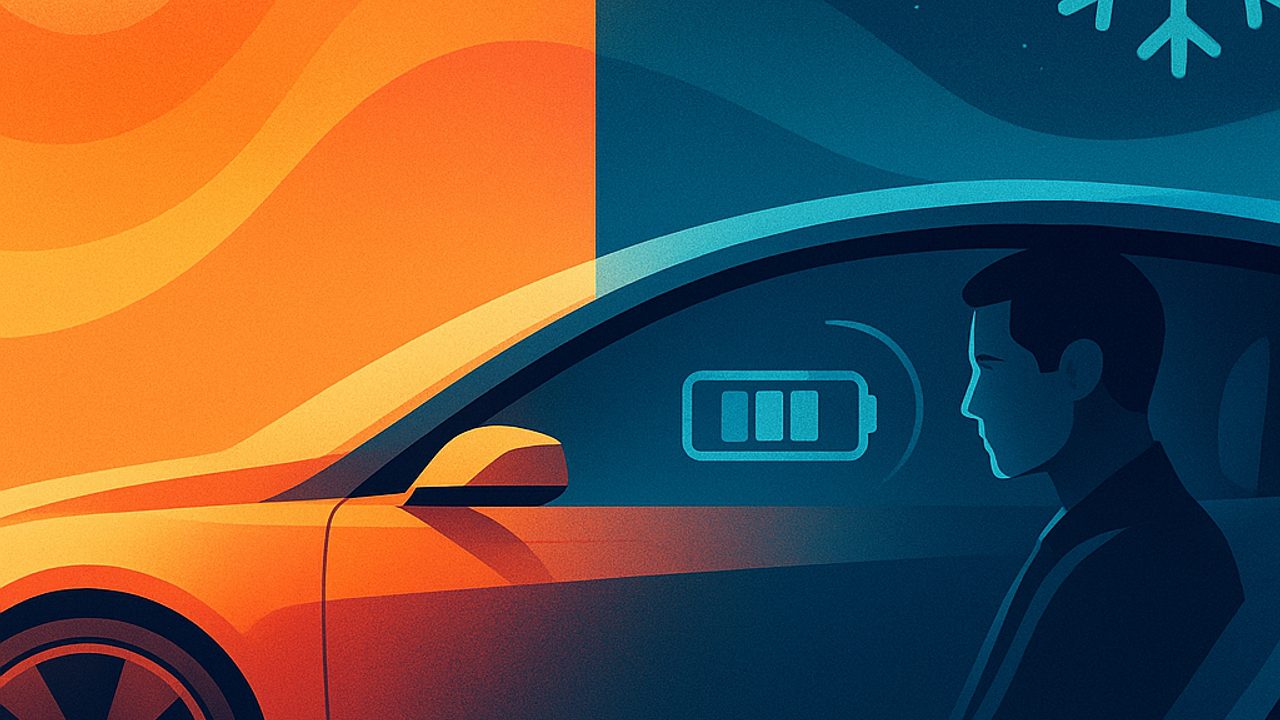
Those new to electric cars often find it strange when range varies without any change in route. The reason is often outside the steering wheel: heat and cold affect the battery, charging, and consumption.
The good news is that you can understand the basics without becoming a technician. Separating myth from fact helps you drive with more predictability — and use less energy.
Myth: temperature doesn’t make a difference in consumption
It does. And it’s not a small one.
In intense heat, the car uses energy to cool the battery and the cabin. In the cold, the battery delivers less energy and cabin heating weighs on consumption. The result shows up on the dashboard: less range for the same trip.
This doesn’t mean a defect. It’s normal operation for any modern battery.
Truth: cold usually impacts range more than heat
In cold regions, range loss tends to be greater. The battery works best within a specific temperature range, usually mild.
In the cold: - Available energy temporarily decreases. - The car uses more electricity to heat the cabin. - Charging may be slower until the battery warms up.
None of this is permanent. When the temperature returns to normal, performance does too.
Myth: air conditioning is the villain of efficiency
It has an impact, but it’s not the main villain.
At urban speeds, the impact of air conditioning is usually smaller than people imagine. On the highway, what consumes the most energy is air moving past the body — not the cool air in the cabin.
Driving with the windows open at 100 km/h usually uses more energy than running the air conditioning moderately.
Truth: preconditioning helps save energy
Preconditioning is adjusting the cabin temperature while the car is still connected to the charger.
This helps because: - The energy comes from the grid, not the battery. - The battery starts driving at an ideal temperature. - Consumption in the first few kilometers drops.
It’s a simple habit, especially useful on very hot or cold days.
Extreme heat: where the hidden cost lies
In intense heat, the cooling system works harder. This consumes extra energy, even if the driver doesn’t notice.
Some practical precautions: - Avoid leaving the car closed in the sun for long periods. - Use shade whenever possible. - Don’t push hard acceleration right after setting off with a very hot car.
These actions don’t work miracles, but they help reduce waste.
Cold and charging: why it takes longer
In the cold, the car may limit charging power until the battery reaches the proper temperature. This protects the system and prevents wear.
To save time and energy: - Plan to charge after driving a few kilometers. - Avoid fast charging with a completely cold battery.
Charging is more efficient when the battery is already at operating temperature.
What really changes for a beginner’s wallet
Temperature alone doesn’t increase the electricity bill. The impact comes from the sum of small habits.
What truly helps: - Gentle driving in the first few minutes. - Mindful use of air conditioning. - Simple charging planning.
With that, heat and cold stop being a scare and become just another normal variable of daily use.
Comments
Comments are public and the sole responsibility of the author. Don’t share personal data. We may store technical signals (e.g. IP hash) to reduce spam and remove abusive, illegal, or off-topic content.